How to Ask for Google Reviews: Why Most Review Strategies Miss the Point
How to ask for Google reviews without a funnel, an app or a bribe. Most small businesses never ask at all. The moment to ask, the words to use, which reviews do which job, and Google's own rules on what you can and can't offer.

By Boostable · 13 September 2026
Websites and SEO for Australian businesses · ~11 min read
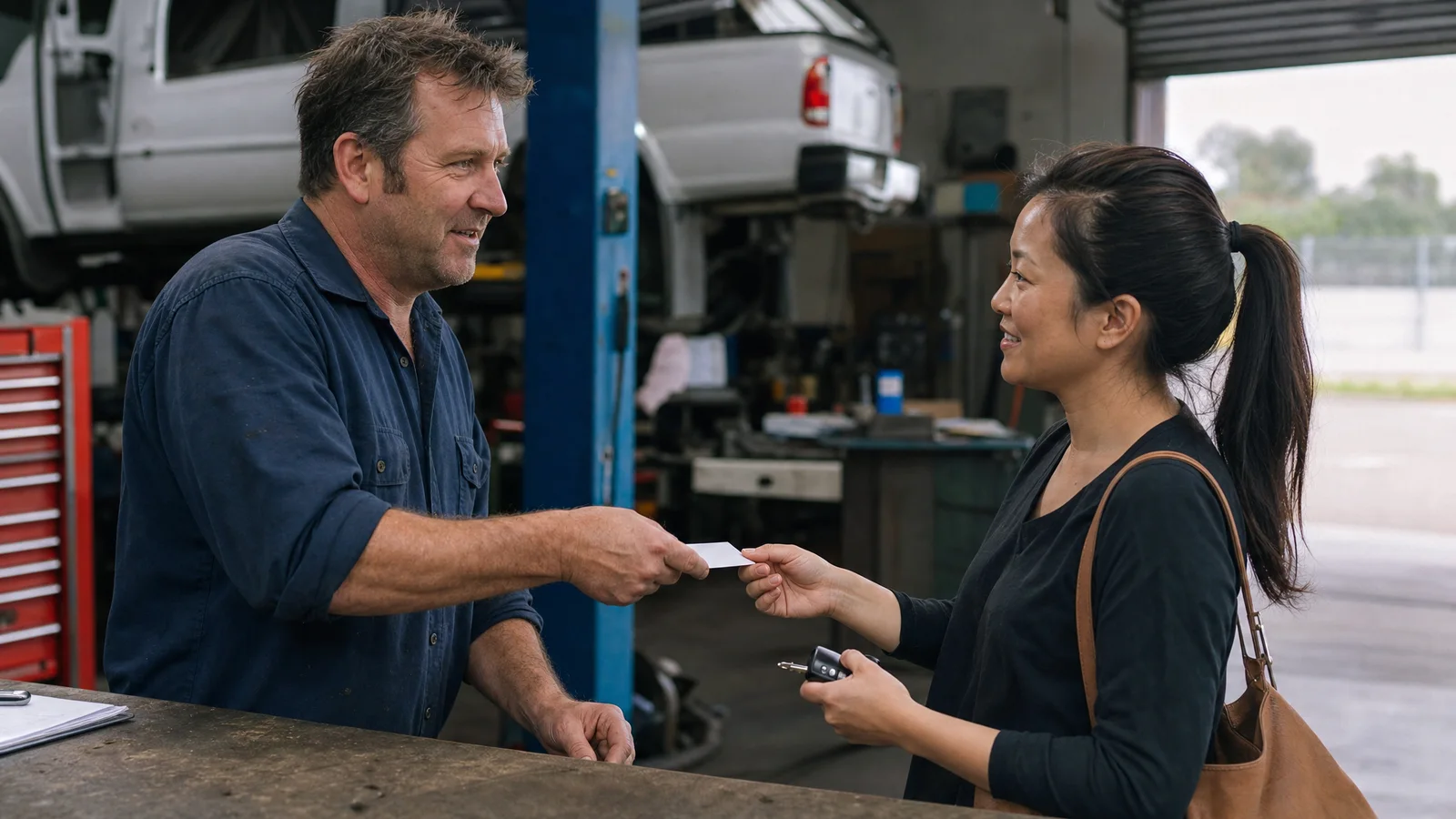
The mainstream line on reviews is clever strategy this, funnel that, automation the other. The real problem is simpler. Most small businesses never ask. Not once. Not at the counter, not in an email, not with a QR code on the receipt. Nothing. So the question of how to ask for Google reviews isn't really about technique. It's about doing it at all, on every job, in a way that doesn't feel like begging.
The big brands worked this out a decade ago. Small and medium businesses outside the capital cities mostly still haven't. That's the gap, and it's the whole gap. The businesses winning the map box aren't running clever funnels. They're asking. Every customer. Every time. This post is the how: the moment, the words, which kind of review does which job, and Google's own rules on where the line is.
- The free review system: the card, the link, the poster and the text, set up for you.
- How to get Google reviews: the Fridges R Us story
- How to respond to Google reviews
- Google reviews for business: how they actually drive sales
Two kinds of reviews, two different jobs
Here's the bit most "review experts" skip. Google reviews and third-party reviews do different jobs. They are not the same tool.
Google reviews feed your local map ranking. When someone in your suburb types "mechanic near me", Google recognises the local intent[8] and weighs, among other things, how many reviews you have. In Google's words, prominence is "based on info like how many websites link to your business and how many reviews you have," and "more reviews and positive ratings can help your business's local ranking."[3] Reviews push you up the map. That's free leads.
Third-party reviews feed your ads. The stars that show under a Google text ad or a Shopping listing come from what Google calls store ratings, collected from review sources outside Google. Google requires "a rating of 3.5 or above" to show them on text ads, and says they "on average drive a 2% improvement in click through rate on the Search network."[4] Useful when you're paying per click. Irrelevant to the map box.
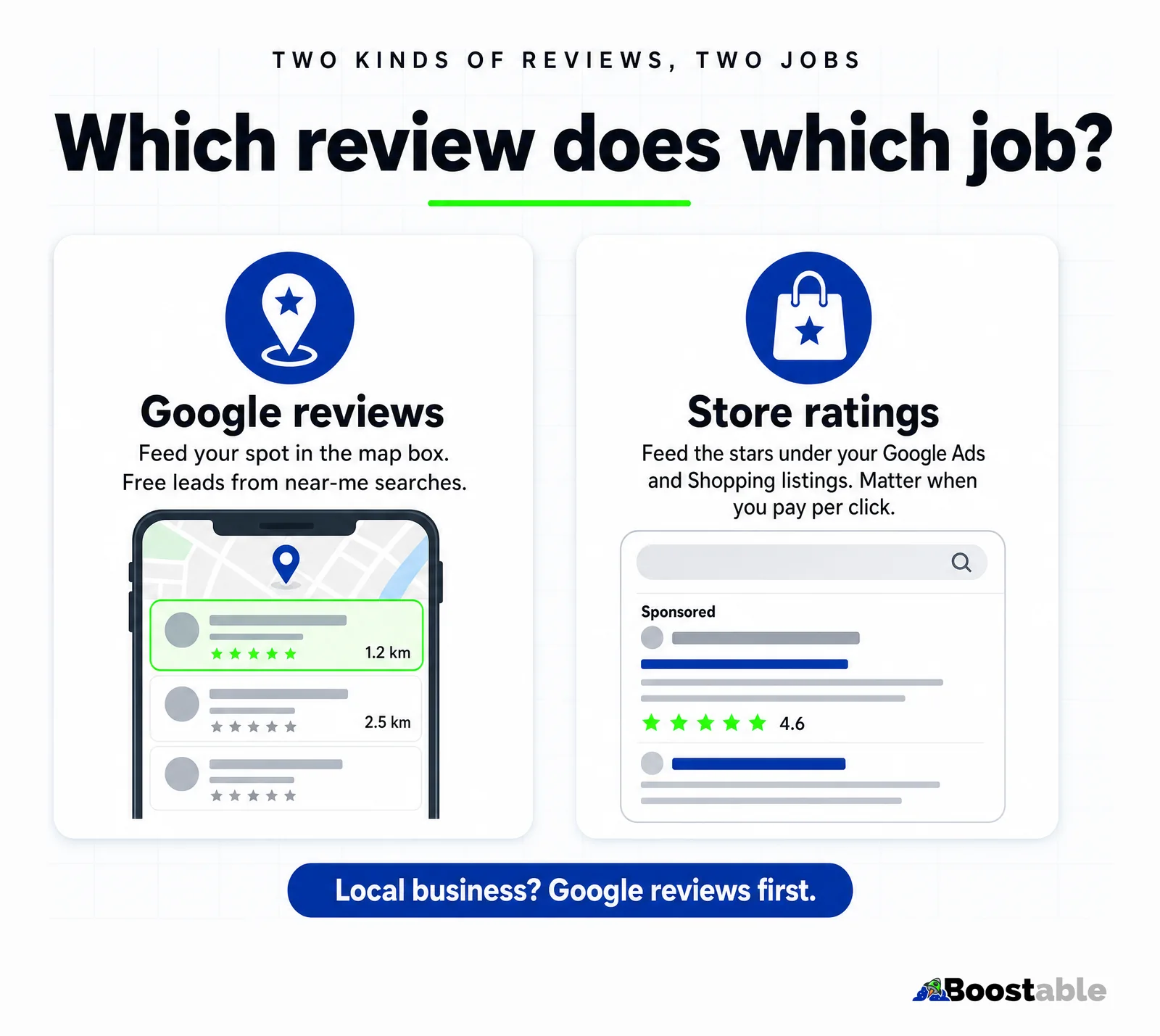
Two tools, two jobs. Most businesses use the wrong one for the job they're doing, or chase both at once and get neither.
Which should you chase first?
Depends on who you are, and there are really only two kinds of business here.
Local service business. You serve a suburb, a city, a region. Customers find you by typing "plumber Brunswick" or "physio Geelong". Google reviews first. That's where your customers look, that's what moves the map, and that's the free lead.
Online shop or national lead generation. You sell online or run big Google Ads campaigns. Store ratings first, because stars under the ad beat no stars, and the ads are where your money goes. Then Google reviews for the trust.
For most small and medium Australian businesses reading this, you're local. Start with Google. Third-party comes later, if at all.
| Google reviews | Store ratings (third party) | |
|---|---|---|
| Where they show | Your Business Profile, the map box, Maps | Under text ads and Shopping listings[4] |
| What they move | Local ranking and trust[3] | Ad click-through, about 2% on average[4] |
| Minimum to show | None; one review shows | 3.5 stars or above[4] |
| Who should chase them first | Any local service business | Online shops and big ad spenders |
| Cost to collect | A card and a text | Usually a paid review platform |
The moment to ask, which most businesses miss
Customers want to thank you. That's the bit nobody tells you. When the plumber walks out the door and the customer says "legend, thank you so much", that's the moment. Not three days later. Not in an email chain. Right then. Your job is to be standing there with the pen when the moment hits.
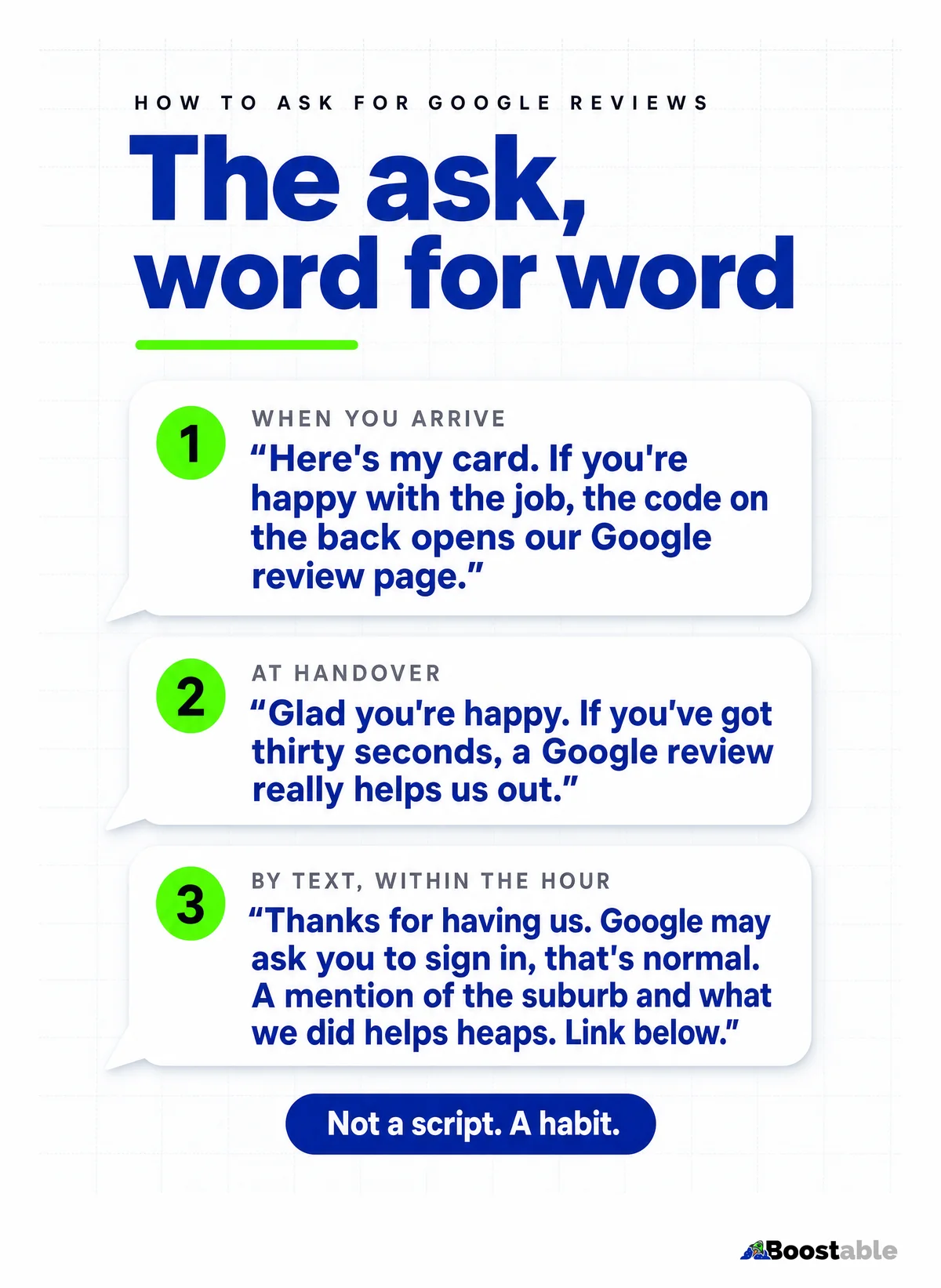
Here's the system, in three beats.
When you arrive: the card. A business card with a QR code on the back that opens your Google review page. Hand it over as you walk in. "If you're happy with the job, the code on the back opens our review page." It plants the seed; the customer knows what's coming. This is exactly what Google suggests: "ask customers to visit a Google link or scan a QR code."[1]
At handover: the ask. Face to face, once they've said thanks. "Glad you're happy. If you've got thirty seconds, a Google review really helps us out." That's it. Don't explain the algorithm. Don't apologise for asking.
If face to face isn't how your business works, the same beat happens wherever the thanks happens: at the till when they say the coffee was great, on the phone when they ring to say the part arrived, in the reply when they email to say the job looks good. The moment is the same. It's the one where the customer is already feeling generous, and you make it easy to act on.
Within the hour: the text. A short message with the direct review link. One tap and the review box is open with the stars ready. An email gets buried; a text gets opened. Make the link the direct one, not your Google page, and warn them about the sign-in: Google notes that "customers must be signed into a Google Account to leave a review,"[1] and the login screen kills more reviews than bad service does.
The card
Sets the expectation before the job. The customer isn't surprised later; they were told.
The ask
Lands at the moment of thanks. Face to face, ten words, no pitch. Most customers say "of course."
The text
Removes every bit of friction: the direct link, the sign-in warning, a hint about what to mention.
What the customer writes matters more than you think
A review that says "Great service, thanks!" is fine. A review that says "Dave came out to our place in Richmond, fixed the hot water system in under an hour, great bloke" is worth ten of those. Google reads reviews. Its ranking explainer says the most basic relevance signal is when content "contains the same keywords as your search query,"[8] and a review naming the suburb and the service is content Google can match to "hot water repair Richmond". Anything a customer says about your business is worth about ten times what you can say about yourself.
So help them write it. Your text can say: "If you've got a sec, a quick mention of the suburb, what we did and who you dealt with makes a huge difference. Thanks again!" Not a script. A hint. They'll write their own words, but they'll mention the right things. What you can't do is ask for a particular rating. Google's policy is that a review "should reflect an actual experience with a business, and be genuine and unbiased,"[2] and Northwestern's research found people buy most readily from businesses rated between 4.0 and 4.7, not a flawless five.[7] A few honest four-star reviews make the five-star ones believable.
"Thamas is an absolute legend. He definitely goes above and beyond to ensure he is giving 100% top notch service and assistance. Could not speak more highly of him. People like this are a rare breed and someone who we can trust without a shadow of doubt. Highly recommend Thamas to everyone."
Aitasi Mariner ★★★★★ Verified Google review
Where the line is: what you can't offer
Everything above is allowed, and Google encourages it. Where businesses get into trouble is the shortcut. Google says offering incentives, "like free or discounted goods or services, in exchange for customers to post reviews, change reviews, or remove negative reviews is considered fake and misleading content and is strictly prohibited."[1] Its content policy adds that merchants may not "solicit or encourage the posting of content that does not represent a genuine experience," and that reviews "paid for, directly or in kind" are removed.[2]
The ACCC is blunter still: "It's against the law for a business to create fake or misleading reviews or to arrange for others to do so," and businesses "must not suppress, edit or remove genuine negative reviews."[5] No discount for a five-star. No staff reviews. No mate's brother. No review-gating, where you only send the link to people you think will be nice. Ask everyone, the same way, and let them say what they like.
The other reason not to cut corners is that fake reviews are easy to spot and expensive to carry. A profile with forty five-star reviews posted in a fortnight, all two words long, all from accounts with no other activity, doesn't look successful. It looks bought, to customers and to Google, and Google says it removes fake engagement. A slower, honest stream, with the odd four-star and a reply under each one, is what a real business looks like.
✓ Allowed, and it works
- A card with a QR code, handed to every customer
- A face-to-face ask at the moment of thanks
- A text with the direct link and a sign-in heads-up
- A hint to mention the suburb and the job
- A two-line reply to every review that lands[3]
The card, the link, the poster and the text template. We set them up for your business for free.
Get the free review systemWhy "we'll set up an automation" usually fails
The other thing the strategy crowd sells is software: an app that sends the review request automatically after every invoice. We've seen dozens of these installed and almost none of them working a year later. The email goes out from a system address the customer doesn't recognise, days after the job, with a generic subject line, and it gets the response a generic email gets. The ask that works is a person, at the moment of thanks, with a card and a text from their own phone.
Automation has a place once the habit exists. If the card and the text are already part of every job, a reminder a week later for the customers who forgot can add a few more. But it's a top-up, not a replacement. The businesses at the top of the map box got there by asking in person, and the ones that bought a tool instead are usually the ones asking us why the tool didn't work.
The trap: review platforms that don't help you
Some lead-generation platforms collect reviews on their own site. Not on your Google profile, not on a store-rating source, on theirs. Those reviews help them. They use them to sell more leads, to you and to four other businesses competing for the same job.
If you're paying for leads on a platform like that, fine; that's a business choice. But the reviews on their site don't lift your Google map ranking, and they don't put stars under your ads. They build their asset, not yours. Own your reviews. Point every customer at Google, or at a store-rating source you control. Nowhere else.
The same goes for the review widgets some website builders push, where the reviews live on the widget company's servers and vanish the day you stop paying. A Google review is yours for as long as the profile exists. Collect them there, then show them on your site with a link back, so every review does two jobs: it ranks you, and it sells you.
Owned leads beat shared leads
When a customer finds you through Google Maps or your website, they've already chosen you. They read your reviews, saw your photos, liked the look of you. By the time they call, the sale is half done. When they come through a shared lead platform, they didn't choose you. They ticked a box and got five quotes, and you're on the phone arguing about price against businesses they've never heard of.
Same customer, two completely different conversations. Reviews are what tips the scale: 82% of adults read them before a first-time purchase,[6] and purchase likelihood with five reviews is 270% higher than with none.[7] Fresh, plentiful, specific reviews are the thing that makes a stranger pick you before they call.
Reviews and the map go together
Reviews on their own won't put you in the map box if the rest of the profile is empty. Google has to know what you do and where before the reviews can rank you for it: the categories, the services, the service areas, the description. Fill that in first, then turn on the asking. We wrote that side up in the Google Business Profile guide, and the reply half in how to respond to Google reviews, because a business that asks and never replies leaves half the trust on the table.
"Excellent work. Extremely helpful and we be continuing our working relationship for the future"
Dru Lazic ★★★★★ Verified Google review
The short version
Most small businesses don't have a review problem. They have an asking problem. Fix the asking and the reviews follow, and the map follows the reviews.
Expect the numbers to be modest and steady rather than dramatic. If you do ten jobs a week and ask on every one, three or four reviews a week is a normal return. That's 150 to 200 a year, which in most suburbs puts you ahead of everyone in the map box within twelve months. The businesses we've watched do this didn't do anything else clever. They just didn't skip a job.
- Get the review card made and put a stack in every vehicle and at the counter.
- Write the handover line and say it out loud once. "If you've got thirty seconds, a Google review really helps us out."
- Save the text template on your phone: thanks, the sign-in heads-up, the hint, the direct link.
- Ask the next five customers, every one, the same way. No picking and choosing.
- Reply to each review that lands, two lines, by name, within a day.
- If you run ads or sell online, look at store ratings after the Google reviews are flowing, not before.
Ask every customer, at the moment they thank you, with the link already in their hand. That's the strategy. Everything else is decoration.