How to Respond to Google Reviews: Stop Putting Out Fires
How to respond to Google reviews so a bad one never looks like a crisis. Reply to every review, two sentences, one detail, and the fake one reads like another Tuesday. Google's own reply rules, the research on what replying does to ratings, and the words to use.

By Boostable · 13 September 2026
Websites and SEO for Australian businesses · ~12 min read


A client rang us in a panic. A fake Google review had just landed: wrong details, wrong timing, and it reeked of a competitor. He wanted to reply right then, and he wanted it to sting. We told him to wait. Not because the review didn't matter, but because of what his reply would have looked like next to everything else on his profile. This post is how to respond to Google reviews so that a bad one, or a fake one, never turns into a fire you have to put out.
The method fits in a sentence: reply to every review, two sentences each, one real detail, and do it before you need to. Google's own guidance backs each part, and there's research on what replying does to your ratings. The words to use are further down.
- Local SEO with Boostable: the reviews, the replies and the profile, kept fed for you.
- How to ask for Google reviews
- Google reviews for business: how they actually drive sales
- How to get Google reviews: the Fridges R Us story
Why replying right now would have made him look worse
Here was the problem. He had never replied to a single review before. Not the good ones, not the mediocre ones, not one, in five years. If he charged in swinging at the fake one, anyone reading it would think the same thing: this bloke only turns up when he's under attack. That's not strength. That's a business caught with its pants down.
Customers aren't just reading what you wrote. They're reading the pattern of when you wrote it. Google puts it mildly: "when you reply to customer reviews, it shows that you value their feedback."[3] The flip side is just as true. Replies only on the bad reviews tell a customer you care about your reputation and not about them.
What we did instead
We ignored the fake one for a day. Then we went back through every review he'd ever had. Five years of them: good, bad, lukewarm. We replied to the lot. Short replies, two sentences each. Thanked the customer, mentioned one thing from their review so it didn't read like a bot.
Then, and only then, we replied to the fake one. Calm, polite, firm. By that point it didn't look defensive. It looked like the same business doing what it always does. Google notes that the reviewer is notified when you reply and "can still change their review after reading your reply."[2] The fake reviewer didn't, of course. But every real customer who'd been thanked now had a reason to think well of him, and the next stranger reading the profile saw a business in control.
The pattern is the whole game
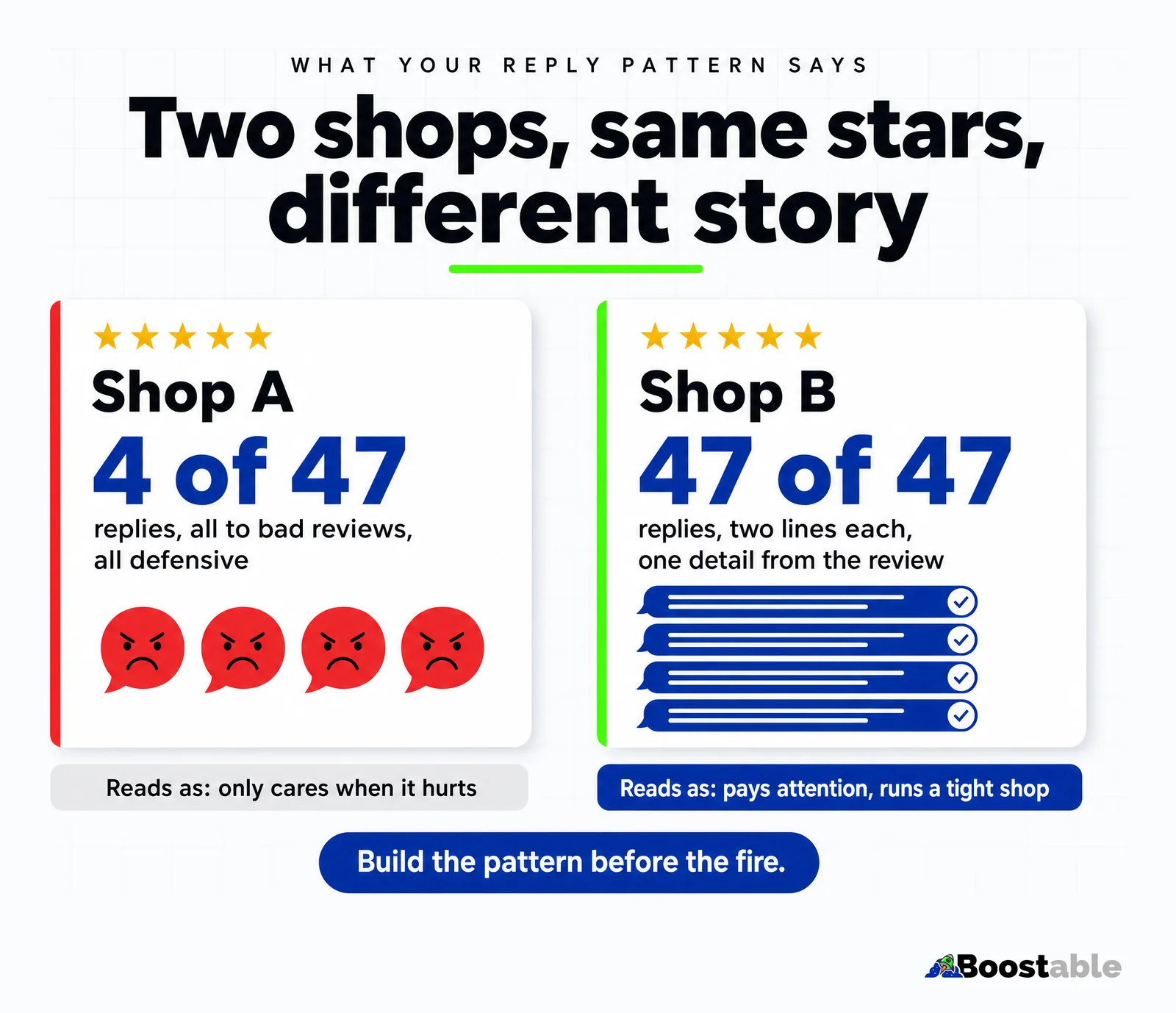
Two businesses, same star rating, different story. Shop A has replied to four of its 47 reviews, all of them bad ones, all of them defensive. Shop B has replied to all 47: thank-yous, follow-ups, calm answers to the two grumpy ones. A new customer reads Shop A as "only cares when it hurts" and Shop B as "pays attention, runs a tight ship." 82% of adults read reviews before a first-time purchase,[8] and the replies are part of what they read.
There's proper research on this. Proserpio and Zervas studied thousands of hotels and found that the ones that started responding to reviews saw "a 0.12-star increase in ratings and a 12% increase in review volume." They also found something subtler: responding businesses received "fewer but longer negative reviews," because "unsatisfied consumers become less likely to leave short indefensible reviews when hotels are likely to scrutinize them."[6] In plain words, when people can see you reply, the drive-by one-star with no explanation mostly stops.
It takes thirty seconds. That's it.
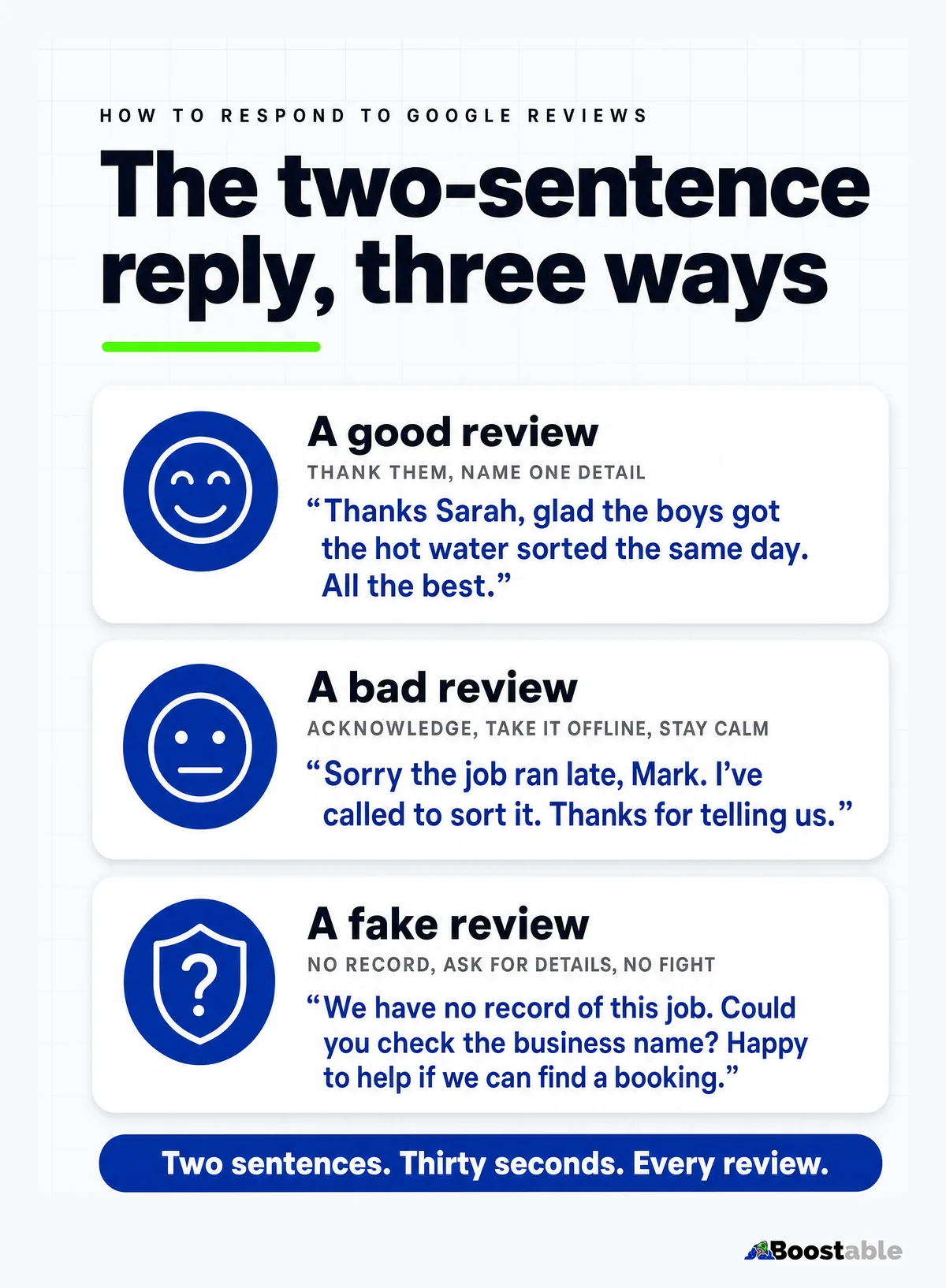
The usual line is "I don't have time." Fair enough; you run a business. But a reply is not an essay. Google emails you every time a review lands. You open the email, tap reply, type two sentences, done. "Thanks Sarah, glad the boys got the hot water sorted the same day. All the best." That's thirty seconds, and that's the whole thing.
Google's own tip agrees: "keep it short and simple," because "if a reply is too long, people might stop reading before they get to the main point."[1] It also asks you to "respond in a timely manner" and to personalise the reply by addressing the reviewer by name.[1] Two sentences, their name, one detail, inside a day. Nobody needs more than that.
The one rule: don't copy and paste
People smell a template from a mile off. "Thank you for your five-star review," the same line under every review, is worse than no reply at all. It tells the customer you ticked a box instead of reading a word. Google says the same: "instead of sending the same 'thank you' to everyone," make your replies count with "a helpful update" or a detail that "reinforces their experience," and be "conversational, not promotional."[1]
Mention the job. Mention the name. Mention the detail. If Bob wrote about the leak under the sink, thank Bob for the chance to fix the leak. One specific thing, every time. That's the whole trick, and it's also what makes the reply useful to Google, which reads your replies as part of the profile.
A few that work, lifted from replies we've written for clients. "Thanks Priya, the Werribee job was a good one, glad the new switchboard is behaving." "Cheers Tom, that gum was a big one, hope the view's worth it." "Thank you Lin, the team liked the biscuits, see you next spring." Notice none of them mention a website, a discount or a five-star anything. Google asks that replies be conversational rather than promotional,[1] and the customer has already bought; the reply is for the next reader.
If you have hundreds of old reviews to catch up on, don't try to make each one a masterpiece. Name, detail, thanks. A reply that's slightly awkward but obviously human beats a polished one that's obviously pasted. And do the old ones from the oldest up, so anyone scrolling sees the pattern going back years, not a burst of replies dated last Tuesday.
"Yesterday restored my faith in technology. Tamhas was so helpfull he is very patient and very good at explaining to the elderly in a professional but caring manner. He was able to talk me through a problem I was having with our Business page on Facebook. Many thanks Tamhas very much appreciated from Sue & Colin Reid Border Collies Glenrowan"
Sue McAllister ★★★★★ Verified Google review
How to respond to a bad review that's real
Sometimes the one-star is earned. The job ran late, the apprentice left a mess, the invoice was wrong. Google's advice for these is the sensible kind. "Negative reviews aren't necessarily a sign of poor business practices," it says; they're "a valuable opportunity to understand customer expectations."[1] Then the mechanics: "apologize when appropriate," "acknowledge if any mistakes were made, but don't take responsibility for things outside your control," and where it's complicated, "politely request that the reviewer contact you via phone or email to resolve the issue privately."[1] Never share their private details, never attack them.
So: "Sorry the job ran late, Mark. I've called to sort it. Thanks for telling us." Then actually ring Mark. A fair chunk of customers update the review once the problem is fixed, and even the ones who don't have left a reply under their complaint that every future reader sees: a business that answered like an adult. What you must not do is try to make it disappear. The ACCC says businesses "must not suppress, edit or remove genuine negative reviews,"[7] and Google says not to report a review "just because you disagree with it or dislike it."[4]
| The review | The reply, in two sentences | Then |
|---|---|---|
| Good | Their name, one detail from what they wrote, thanks[1] | Nothing. Next one. |
| Bad and fair | Sorry, one honest sentence, and "I've called to sort it"[1] | Fix it offline. Don't ask them to delete it.[7] |
| Bad and unfair | Calm, factual, no argument, offer to talk by phone | Let the reply do the work. Readers can tell. |
| Fake | "We have no record of this job. Could you check the business name?" | Report it if it breaks policy; expect several days.[4] |
Replies only work if reviews keep coming. The card and the text that bring them in are free.
Get the free review systemWho should write the replies
The owner, or whoever actually did the job. Not an agency, not an app, not a template that fills in the name. The detail that makes a reply land ("the switchboard", "that gum") is the detail only someone who was there knows. When we run local SEO for a client we bring the reviews in and flag each new one the same day, but the two sentences come from the person whose name is on the van, because customers can tell, and Google says your reply appears as the business rather than a personal name,[2] so it carries the business's voice whether you like it or not.
Make it someone's job. Google's email arrives; whoever owns that inbox replies before knock-off. If nobody owns it, the pattern breaks in the first busy fortnight and you're back to silence with a fire waiting.
When the fake review finally lands
It will, sooner or later. A competitor, a scammer, someone who's got you mixed up with another business. If you've been replying to every review for a year, your reply on the fake one reads like another Tuesday. "Hi, we don't have a record of this job. Could you check the business name? Happy to help if we can find the booking." Calm, polite, normal, because for you it is normal.
The new customer reading it thinks "something's off about that review, not the shop." That's the difference between looking like you're scrambling and looking like you're in charge. Then report it. Google removes reviews that break its content policy, which includes content "not based on a real experience" and anything posted "on a competitor's place or business to undermine" it,[5] and says "review evaluation typically takes several days."[4] Your reply is live in the meantime, doing the job.
✓ Build it
- Every review answered, good and bad, within a day
- Two sentences, the customer's name, one real detail
- An apology where one is owed, and a phone call to fix it
- The fake one answered like any other, then reported
- No offers, no promotions, no sales pitch in a reply[1]
What a reply is for, and what it isn't
A reply is for the next reader. That's the mental shift that makes all of this easy. You're not writing to Bob, who's already happy or already cross. You're writing to the stranger who will read Bob's review in six months while deciding between you and two other businesses in the map box. Every reply is a small, public demonstration of what it's like to deal with you.
Which is why the tone matters more than the argument. Nobody reading a one-star review and a furious owner reply thinks "well, the owner made some good points." They think "I don't want to deal with that." And nobody reading a one-star review and a calm, two-line offer to sort it out thinks less of the business. They think the reviewer was probably having a bad day. You don't win the argument by winning it. You win it by being the reasonable one in public.
The reply is also not the place to fix the problem. Google's advice is to move anything complex to a phone call or an email,[1] and that's right: the public reply says "I've called," and the call does the work. Refund, redo, apology, whatever it is, it happens off the page.
Where this fits in your Google ranking
Replies aren't only a reputation trick. Google lists "respond to reviews" among its own tips for improving local ranking, alongside keeping your information complete and adding photos, and says "positive reviews and helpful replies can help your business stand out."[3] An active profile with fresh replies reads as a business that's alive, to Google and to the customer choosing between three listings in the map box.
Review strategy and local SEO aren't two jobs; they're the same job. The asking half is in how to ask for Google reviews, and the bigger picture of what reviews do to sales is in how Google reviews actually drive sales.
"Great team. Tamhas is very knowledgeable and gave great advice on our existing site and what could be improved. He loves going into details and really trying to help out as much as he can. I really recommend Boostable and Tamhas. Thanks guys."
Marcus Whelan ★★★★★ Verified Google review
Start today, not next month
Don't wait for the fake review or the bad one. Build the pattern before you need it. An afternoon's work, maybe two, and then it's thirty seconds a review for life.
If the backlog is in the hundreds, split it across a week: twenty a night, oldest first. It's dull, and it's the single cheapest improvement most profiles can make, because every one of those old reviews is still being read by someone deciding whether to ring you.
- Open your Google Business Profile and read every review you've ever had. All of them.
- Reply to each one: two sentences, their name, one detail from what they wrote. Oldest first.
- For any genuine bad review, apologise in the reply and ring the customer today.
- For anything fake, reply calmly that you have no record, then report it.
- From now on, reply to every new review within a day. Google emails you when one lands; do it from the email.
- Keep the reviews coming with the card and the text, so there's always something recent to reply to.
Build the pattern before the fire starts. Then there's no fire to put out. And when one does start, you'll answer it the way you answer everything: two sentences, calmly, and on to the next job.