How to Get Google Reviews: The System That Took Fridges R Us From Zero to 740 in 18 Months
How to get Google reviews without begging or bribing. The card-and-text system that took a Sydney fridge repairer from no profile to 740 reviews in 18 months (831 today), what it did for three other trades, and Google's own rules on asking.

By Boostable · 13 September 2026
Websites and SEO for Australian businesses · ~12 min read


Danny at Fridges R Us in Sydney didn't have a Google Business Profile until late 2023. He was already paying serious money for Google Ads and getting leads from them, and missing the cheapest tool in local marketing entirely. Eighteen months after the profile went up he had 740 Google reviews. When we checked again on 13 September 2026, the count was 831, rated 5.0. No extra ad spend. Just a few things fixed properly and one habit kept up. This post is how to get Google reviews the way he did, and what the same system did for three other trades.
There is nothing clever in it. That's the point. A card, a text, and a business that asks every time. What follows is the whole method, with Google's own rules on asking quoted so you know where the line is.
- Local SEO with Boostable: the profile, the suburb pages and the review system, done for you.
- Google reviews for business: how they actually drive sales
- Why most Google review strategies miss the point
- Google Business Profile optimisation: the complete guide
The same pattern in every audit
We've been building websites since 2008 and running Boostable full time since 2021. The pattern never changes. We open a business's Google Maps listing: empty service fields, five reviews collected over ten years, a description that says "quality service" and not much else. Then we look at the website: generic copy that could fit anyone in the trade, nothing about how they actually help, nothing about what makes them different.
The knowledge is in the owner's head. It never made it onto the screen. Competence without communication is invisible, and it doesn't matter how good you are if nobody can read it. Google's own line is that "businesses with complete and accurate info are more likely to show up in local search results."[2] The profile is free to claim,[8] and most businesses have claimed it and stopped there.
Why questionnaires fail and conversations work
Most web designers send a form. The owner stares at a blank field that says "what makes you different" and types something vague. They're not writers. They're sparkies, arborists, fridge mechanics. They can talk about their trade brilliantly over a beer; writing it down is a different sport.
So we stopped asking them to write. We ring them up, record the call, ask follow-up questions, and dig into the details that matter to a customer. Then we put those words on the website and on the Google profile. Customer's language, owner's detail. That's the first half of getting found. Reviews are the second half, and they work the same way: the customer's words, not yours.
With Danny the call covered what actually goes wrong with a commercial fridge on a Friday night, which brands he'll touch and which he won't, how fast he can get to a cafe in the inner west, and what a callout costs. None of that was on the old site. All of it went on the new one, and it's the same detail that shows up, unprompted, in the reviews his customers now write.
The two-tier game
Getting found locally works in two tiers. Miss the first and the second can't save you.
Tier one: you tell Google everything you do. Every service, every suburb, every category. If you never mention "emergency electrical" on your profile or your website, you're not in the running when someone types it in. Google's ranking explainer says the most basic relevance signal is when "content contains the same keywords as your search query."[6] No words, no match.
Tier two: what customers say about you. Google uses their words to match you to searches. A customer who writes "they removed three oak trees from my yard in Wyndham Vale on Tuesday" has just told Google your service and your suburb in one sentence, and it's worth ten of your own marketing lines. Google confirms reviews feed prominence: it's "based on info like how many websites link to your business and how many reviews you have," and "more reviews and positive ratings can help your business's local ranking."[2]
Most businesses fail at tier one. So tier two can't help them. And tier two is where the sale is decided once you're in the box. Pew Research found 82% of adults read online reviews before a first-time purchase.[4] Northwestern's Spiegel Research Center found purchase likelihood with five reviews is 270% higher than with none, and that it peaks between 4.0 and 4.7 stars rather than at a perfect five.[5] A steady stream of real, slightly imperfect reviews beats a handful of flawless ones, because it looks like what it is.
The review system that actually works
Aps Tree Removal in Melbourne's west had zero reviews when we started and was buying leads from a directory because Google Maps didn't know he existed. We set up his profile, built him a single-page site, and gave him two tools.
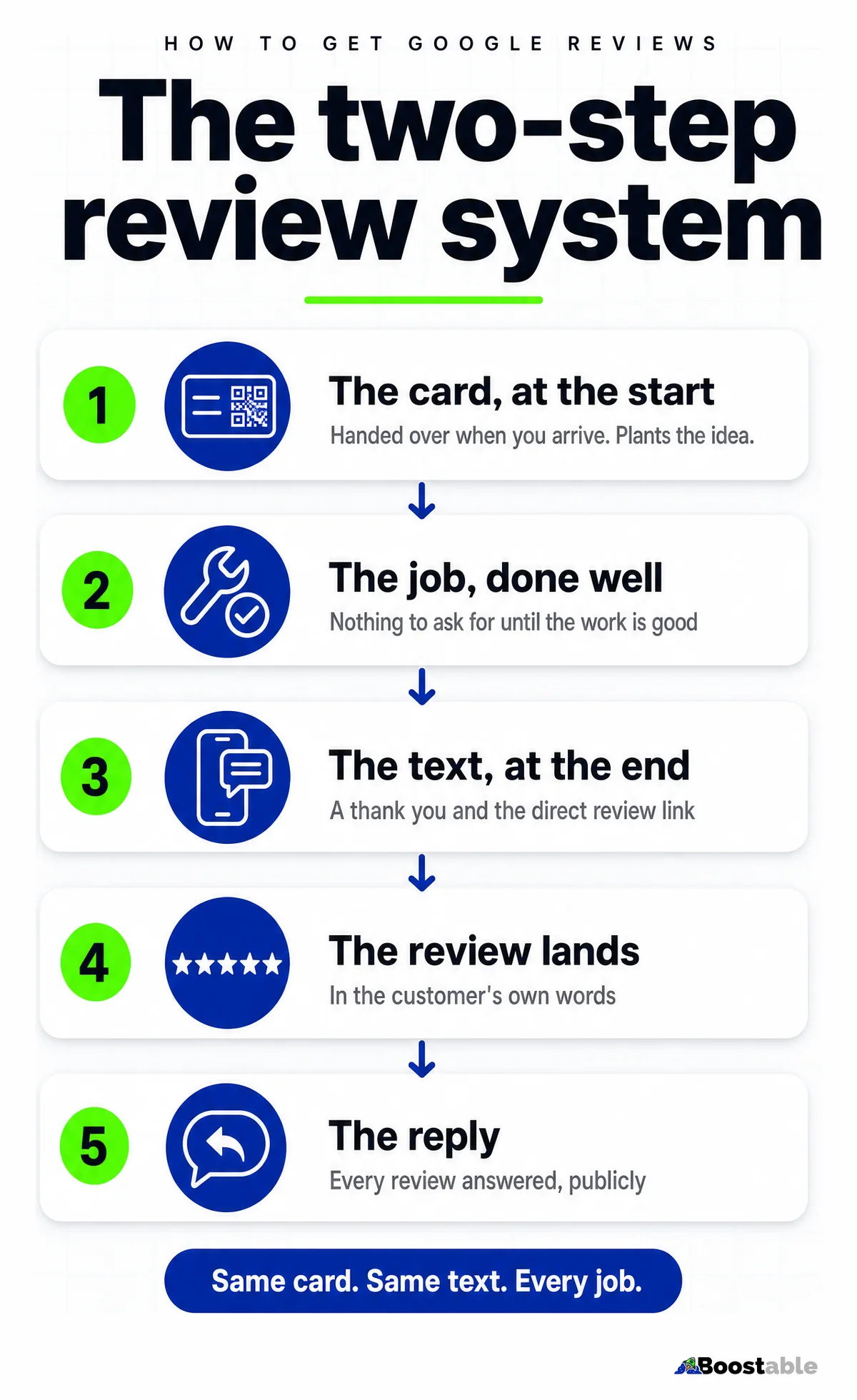
The card. A business card with a QR code on the back that opens the Google review box. He hands it over when he arrives. It plants the idea before the work starts, and the customer knows a review is coming. Google itself suggests exactly this: "ask customers to visit a Google link or scan a QR code."[1] We make that card for free on our review card page.
The text. At the end of the job he says, "No worries, mate. I'll send you the review link." The text explains what to expect, warns them Google may ask them to sign in, suggests a few things they might mention, and carries the direct link. When they tap it, the review box opens with the stars ready. Every point of friction removed.
The text itself matters more than people think. Ours is four short lines. Thanks for having us today. Google might ask you to sign in first, that's normal. If you can, mention what we fixed and which suburb you're in. Then the link. That last hint is the tier-two trick: the customer names the service and the suburb, and Google reads it. We don't script the review, and we don't ask for five stars. We ask for a review.
Timing is the other half. The text goes within the hour, while the fixed fridge is humming and the relief is fresh. Three days later the moment has passed and the reply rate falls off a cliff. On a busy day the text is the last thing done before the van pulls away.
Most businesses don't get reviews because they don't ask, or they feel like they're begging. This takes the begging out. You're giving the customer an easy way to say thank you.
What you can't do is pay for it. Google says offering incentives "in exchange for customers to post reviews, change reviews, or remove negative reviews is considered fake and misleading content and is strictly prohibited."[1] The ACCC is blunter: "It's against the law for a business to create fake or misleading reviews or to arrange for others to do so," and businesses "must not suppress, edit or remove genuine negative reviews." It has fined Service Seeking $600,000 and HealthEngine $2.9 million over review conduct.[3] Ask everyone, the same way, and let them say what they like.
"Tamhas is professional, extremely quick and generous with his time in explaining what he's done. He goes above and beyond with explainer videos to educate us and enable us to fix our own problems in the future. He is diligent in checking up on our site and whether we need help with anything. I can't recommend Tamhas and his work enough."
Jemma Douglas ★★★★★ Verified Google review
Four businesses, one system, the counts today
The same card and the same text, in four different trades. We checked every count on 13 September 2026 rather than quoting what they were when we first wrote this, so you can run the searches yourself.
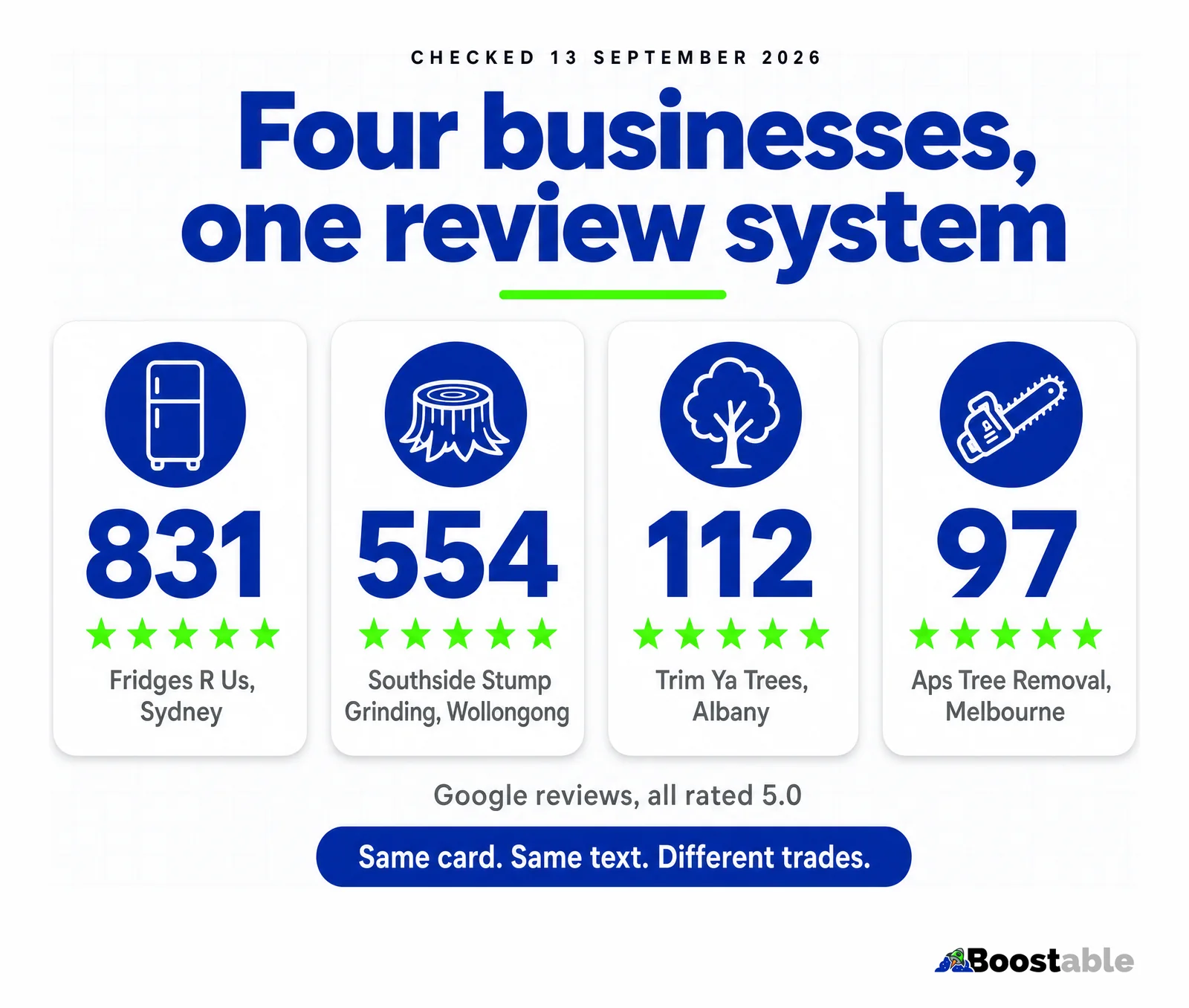
| Business | Trade and place | When the system went in | Reviews today |
|---|---|---|---|
| Fridges R Us | Commercial fridge repairs, Sydney | Profile created late 2023; 740 reviews by mid-2025 | 831, rated 5.0 |
| Southside Stump Grinding | Stump removal, Wollongong | Around 100 reviews when we started; 500 two years later | 554, rated 5.0 |
| Trim Ya Trees | Tree removal, Albany WA | Listing recovered June 2024 with about 5 reviews; 54 by September 2024 | 112, rated 5.0 |
| Aps Tree Removal | Tree removal, western Melbourne | Zero reviews at the start | 97, rated 5.0 |
Gary at Trim Ya Trees is the one that shows how fast it moves. His listing was dead when we found him; he'd shut it down during a business reset. We recovered it, reinstated it, filled in every field and set the location right. That was June 2024, with maybe five reviews from ten years of trading. By September he had fifty-four. Same card, same text. Today it's 112.
Note what isn't in that table: a single review anyone was paid for, or a single review written by us. Every one is a customer who was handed a card, did a job with the business, and got a text. Google's guidance on replies applies to all of them too: "when you reply to customer reviews, it shows that you value their feedback."[2]
The card and the text are the whole system. We'll set them up for your business for free.
Get the free review systemWhy location pages changed everything for Aps
Aps Tree Removal was ranking in Melbourne's south-west: Hoppers Crossing, Point Cook, Wyndham Vale, Werribee. Then we built location pages, one per suburb and service, with unique content for each. Google saw the dedicated pages and worked out he actually serves those places, and he started showing up across most of western Melbourne rather than just the corner he lives in.
The profile can list up to 20 service areas,[7] and you should list every one you work in. But a service area on the profile tells Google where you go; a page on the site tells Google what you do there, in the words a customer in that suburb types. The reviews then do the rest: a customer who names the suburb in a review has written your location page's best paragraph for you.
✓ Get them every week
- The card is handed over at the start of every job
- The text goes out within an hour of finishing
- The link opens the review box directly, stars ready
- Every review gets a two-line reply
- Nobody is offered anything for it
✗ Get four a year
- "We should really ask for more reviews" said in the ute, never done
- A link to the business's Google page, not the review box
- Asked three days later, when the customer has moved on
- Only the happy-sounding customers asked, so the tone is off
- A discount offered for a five-star, and the profile flagged
Content appreciates. Ads don't.
Paid ads stop the second you stop paying. Content gets more valuable over time: every month it sits there, it ranks a little higher, more traffic finds it, more leads come off it. We're not saying don't run ads; they're a good booster, and Danny still runs his. But one is rent and the other is an asset. Reviews are the purest version of that. A review left in 2024 is still selling for you in 2026, and it cost nothing but a card and a text.
There's a compounding effect too. Every review is another sentence Google can match to a search, so the profile ranks for more of the things customers type. Ranking higher brings more jobs, more jobs bring more cards handed over, more cards bring more reviews. Danny's 831 didn't come from 831 asks in a row; they came from a system that fed itself once it was running.
The mistake after launch
You fix the website, sort the profile, get some reviews, and then you stop. Your competitors don't stop. Younger businesses figure out the game, fill in their profiles, collect reviews, and write detailed content about what they do. Six months later they're ranking above you. You don't have to outrun the tiger; you have to keep walking while the other business sits down.
The tell is the date on the newest review. Open any profile and look. If the most recent one is four months old, the business has stopped asking, whatever it says about itself. Google can see that date too, and so can the customer choosing between three businesses in the map box. Recency is the cheapest signal there is, and the card and the text keep it fresh without anyone having to remember.
The other thing that stops is replying. Google says replying shows customers you value their feedback,[2] and a profile with 300 reviews and no replies reads as a business that stopped paying attention around review 50. Two lines, by name, within a day. It takes less time than reading this paragraph.
"Thank you so much Tamhas for being so honest, hardworking and proactive on our website and marketing endeavours. Tamhas and the team worked on our catering business website in Melbourne and did a phenomenal job on what was a clunky old site that broke all the time. Look forward to a great working relationship moving forward."
Ana K ★★★★★ Verified Google review
What this actually takes
Not much, which is why it works. The card takes a minute to hand over. The text takes thirty seconds to send. The reply takes two lines. The hard part is doing it on every job for eighteen months, and that's a habit, not a skill.
- Claim and verify your Google Business Profile if you haven't, and fill every field: categories, every service, every suburb.
- Get the review card made, with the QR code on the back, and put a stack in every vehicle.
- Write the text once: thank you, the sign-in heads-up, what to mention, the direct link. Save it as a template on your phone.
- Ask on the next job, and every job after it. Send the text within the hour.
- Reply to every review within a day, two lines, by name.
- Count the reviews at the end of each month. If the number isn't moving, the card isn't being handed over.
Danny went from no profile to 831 reviews on this. Gary went from five to 112. None of it needed a bigger budget, only a business that asked every time, the same way. If you'd like the card and the text set up for yours, that's what our free review system is.