Google Reviews for Business: How They Actually Drive Sales
Google reviews for business do two jobs: they lift your Google Maps listing, and they make the phone ring. Here is exactly how each one works for an Australian small business, with the numbers, and the simplest way to get more of them without asking.

By Boostable · 13 September 2026
Websites and SEO for Australian businesses · ~14 min read


A customer hunts for a plumber on their phone. Three businesses come up in the map. All local, all open, all within twenty minutes. One has 4 reviews from 2021. One has 38 reviews and a reply under every one of them. One has 112 reviews, the latest from last Tuesday, and a photo of the van. You already know who gets the call.
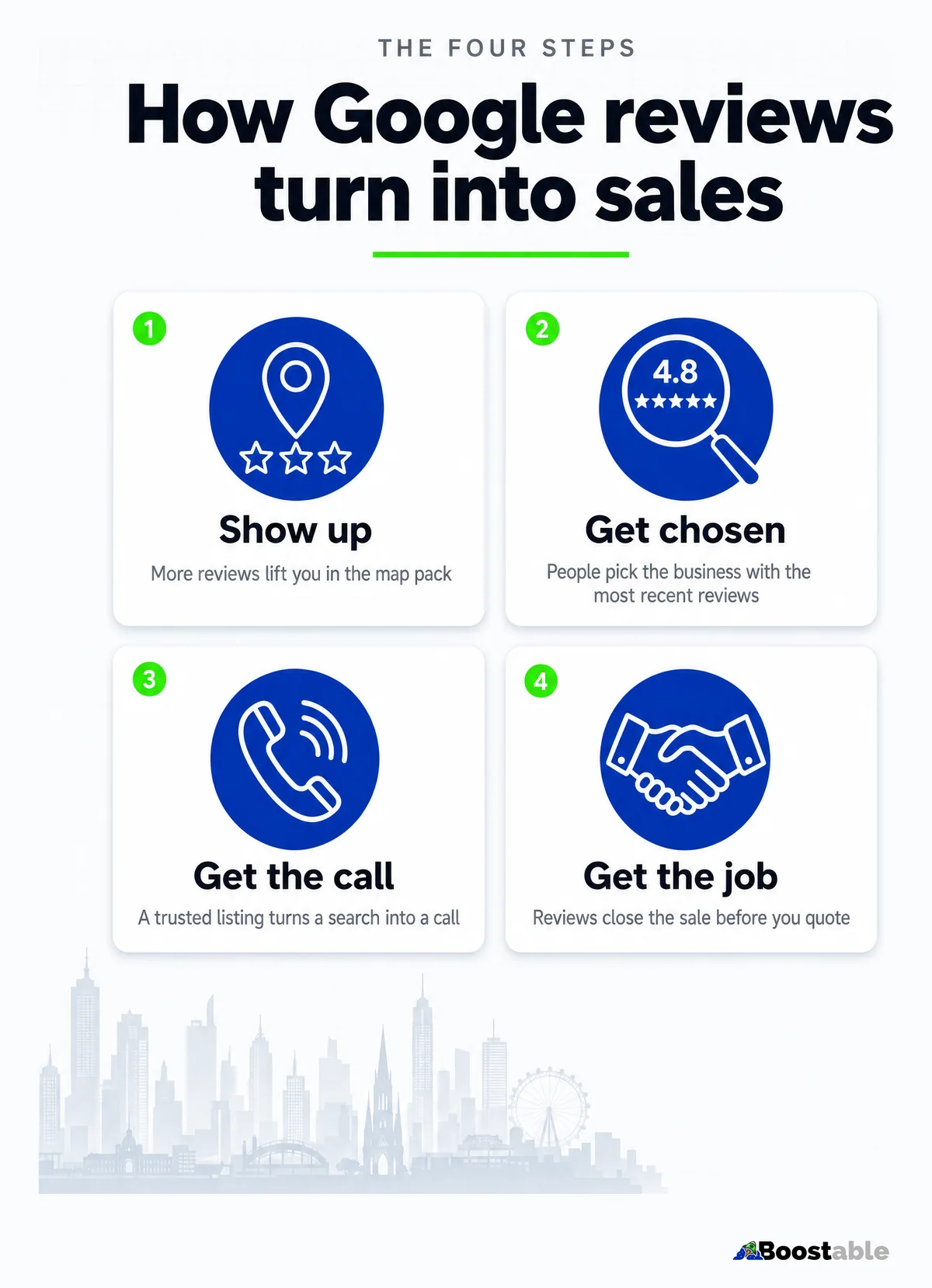
That is the whole argument for Google reviews for business, and it has two halves that most owners run together. Reviews decide whether you show up in that map at all, and then they decide whether you get chosen once you're there. They are the ranking factor and the closing argument at the same time.
This guide walks through both jobs with the numbers behind them, explains why so many good businesses get stuck at a dozen reviews, and shows the simplest system we know for getting a steady stream of them without ever having to ask.
- The free Google review system: the card, the poster and the text, set up once.
- Why most Google review strategies miss the point
- From zero to 740 Google reviews in 18 months: a Sydney case study
- Stop putting out fires on Google reviews
What Google reviews for business actually do
Google is unusually plain about this. It says local ranking comes down to three things: relevance, distance and prominence. Under prominence, it says it looks at "how many websites link to your business and how many reviews you have," and that "more reviews and positive ratings can help your business's local ranking."[1] That is not an SEO theory. It is Google's own help page.
The other half is human, not algorithmic. Reviews sit right next to your name in Maps and Search, so they're the first thing a stranger learns about you.[5] Pew Research found that 82% of adults at least sometimes read online reviews before buying something for the first time, and 40% always or almost always do.[2] For a tradie or a clinic, almost every job is a first-time purchase from the customer's side. They are reading.
Put the two halves together and reviews are the only marketing asset that improves your ranking and your conversion rate at the same time. A better website helps you convert. Ads help you show up. Reviews do both, and they cost nothing but a system.
Job one: reviews move you up the map
When someone searches "electrician Frankston" or "physio near me", Google shows the map pack before it shows any websites. Three businesses, a map, a rating next to each. Most people never scroll past it. Winning that box is local SEO in one sentence.
Google fills those three spots using the three factors above. You can't do much about distance. Relevance is your profile: the right categories, services and a proper description. Prominence is where reviews live, alongside links and mentions from around the web.[1] Of those three, reviews are the one a small business can move fastest, because every job you finish is a chance to add one.
Three things about your reviews seem to matter most to the map pack, based on what Google says and what we see across our clients' profiles every month.
How many
Google names review count directly. The business with 112 has a prominence advantage over the one with 4, everything else being equal.
How recent
A dozen reviews from three years ago tells Google, and the customer, that things have gone quiet. A steady trickle says you're busy now.
What they say
Reviews that name the job and the suburb ("fixed our hot water in Cranbourne the same day") help Google match you to that search.
Whether you reply
Google says positive reviews and helpful replies help your business stand out. Replies also show the next reader that someone is home.
The recency point is the one owners miss. Google doesn't just count; it watches the pattern. A business that collected forty reviews in its launch month and none since looks less alive than one adding two a week. This is why a system beats a campaign, and we'll come back to it.
Here is what that looks like when it works. Anthony runs a family business on the New South Wales south coast. We set up his website, his logo and his Google pages, and put the review system in from the start. His own words, from his Google review of us:
"I would highly recommend Tamhas! He designed a website for us, did a logo and created google pages. We are a local family business in Callala Bay and Tamhas increase our business from 1 job a week to 7+. We are now struggling to keep up with all the work. We can't thank him enough!"
Anthony Dahdah ★★★★★ Verified Google review
One job a week to seven wasn't the website on its own. It was the website, the profile and the reviews arriving together, so that when Callala Bay searched, he showed up, and when they looked, he looked like the safe choice.
Job two: reviews make the phone ring
Showing up gets you looked at. Reviews get you picked. The research on this is unusually consistent, and it comes from people with no product to sell you.
Northwestern University's Spiegel Research Center studied purchase behaviour against review counts and found that "the purchase likelihood for a product with five reviews is 270% greater than the purchase likelihood of a product with no reviews."[3] The effect was bigger for expensive things: a 190% lift for lower-priced products and 380% for higher-priced ones.[3] A new kitchen, a rewire, a tree removal: these are higher-priced decisions, and the customer wants proof before they commit.
Michael Luca at Harvard Business School matched restaurant ratings to actual revenue data from a state revenue department and found "a one-star increase in Yelp rating leads to a 5-9 percent increase in revenue." The effect was "driven by independent restaurants"; ratings did not move the chains.[4] In plain terms, reviews matter most to exactly the kind of business that has no brand to lean on, which is every small business in Australia.
Two more findings from the Northwestern work are worth keeping in your head. First, the sweet spot is not five stars. "Purchase likelihood typically peaks at ratings in the 4.0 to 4.7 range, and then begins to decrease as ratings approach 5.0."[3] A perfect 5.0 from nine reviews reads as thin, or as friends and family. Second, "the marginal benefit of additional reviews begins diminishing rapidly after the first five reviews."[3] The first five are the ones that take you from unknown to credible. After that, it's about staying recent and out-counting the businesses next to you.
| They glance at | What it tells them | What you control |
|---|---|---|
| The number of reviews | How many people have trusted you before | Asking every customer, not just the happy ones |
| The star rating | Whether you're safe to call | Doing good work, and fixing it when you don't |
| The date of the latest review | Whether you're still in business and still busy | A system that asks after every job |
| The words in the reviews | Whether people like them had a problem like theirs | Prompting customers to mention the job and the suburb |
| Your replies | What you're like to deal with | Replying to all of them, especially the bad ones |
Notice how much of that third column is about asking. Doing good work is the entry ticket, but it does not put reviews on your profile by itself. Happy customers rarely think to write one. The ones who write unprompted are, more often, the ones with a grievance.
Want the review system that does the asking for you? It's free.
Get the free review systemWhy most businesses stall at a dozen reviews
We have looked at hundreds of Google Business Profiles for Australian trades, clinics and shops. The pattern repeats. A burst of reviews when the business opened, from friends, family and the first few customers. Then a long flat line, with a new one appearing every few months when someone was either delighted or furious.
It is not that the owners don't know reviews matter. Three things get in the way, and they're all human.
Asking feels awkward. At the end of a job, when the customer is happy and reaching for their wallet, most tradespeople would rather do anything than say "could you leave me a review?" It feels like begging. So they say "I'll send you a link," and then the van is on the next job and the link never gets sent.
The customer has to do too much. Even when the ask lands, the customer has to find the business on Google, find the reviews, work out how to leave one, and log in. Every step loses people. A link that opens the review box directly, or a QR code that does the same thing, removes almost all of the drop-off.
The shortcuts are illegal. The tempting fixes, a discount for a review, a mate who "owes you one", a staff member with a spare Gmail account, are exactly what Google and the ACCC police. Google says offering incentives "in exchange for customers to post reviews, change reviews, or remove negative reviews is considered fake and misleading content and is strictly prohibited."[5] Its Maps policy bans reviews "that have been paid for, directly or in kind" and content "posted from multiple accounts by or at the request of one person," and the consequences run from removal to account termination.[7]
The ACCC is blunter. "It's against the law for a business to create fake or misleading reviews or to arrange for others to do so."[6] Reviews written by family, employees or anyone paid by the business need the relationship disclosed. Incentives, if you offer them at all, "must be applied regardless of whether the reviewer leaves a positive or negative review" and must be clearly disclosed.[6] The penalties it lists are not small: $600,000 against Service Seeking and $2.9 million against HealthEngine.[6]
✓ Do this
- Ask every customer the same way, at the end of every job
- Hand them a card or send a link that opens the review box directly
- Tell them what's helpful to mention: the job, the suburb, how it went
- Reply to every review, good and bad, within a few days
- Let the mix of ratings stand; a 4.6 reads as real
✗ Never this
- Offer a discount, gift or draw entry for a review
- Ask only the customers you know were happy
- Get staff, family or mates to review the business
- Buy reviews, or post from more than one account
- Ask Google to remove a genuine negative review
The businesses that get past the dozen-review wall are not the ones with the best customers. They are the ones that stopped relying on remembering to ask and built the ask into the job itself.
The two-step system that gets reviews without asking
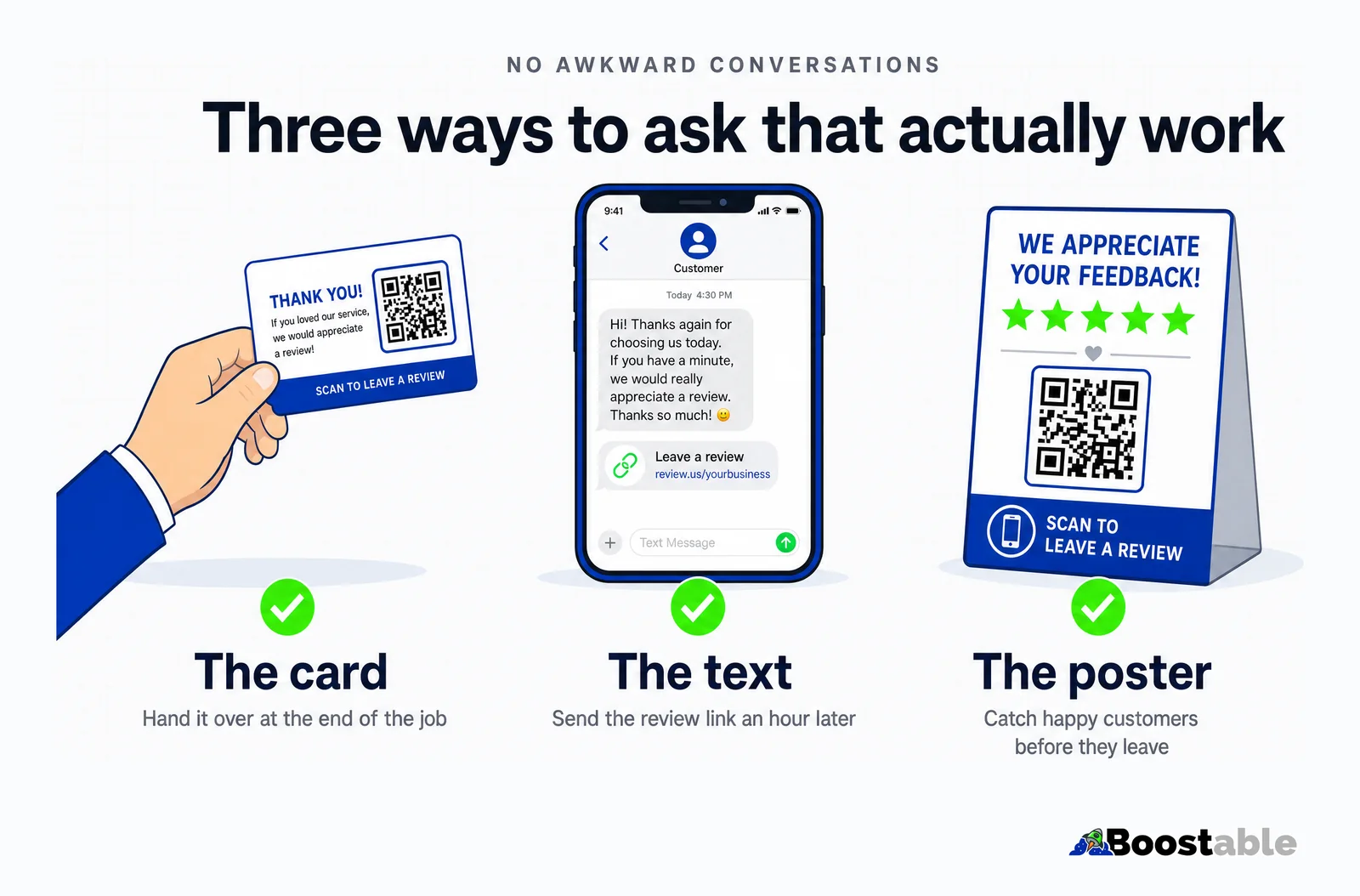
Everything we set up for clients comes down to two steps, and neither of them involves saying the word "review" out loud.
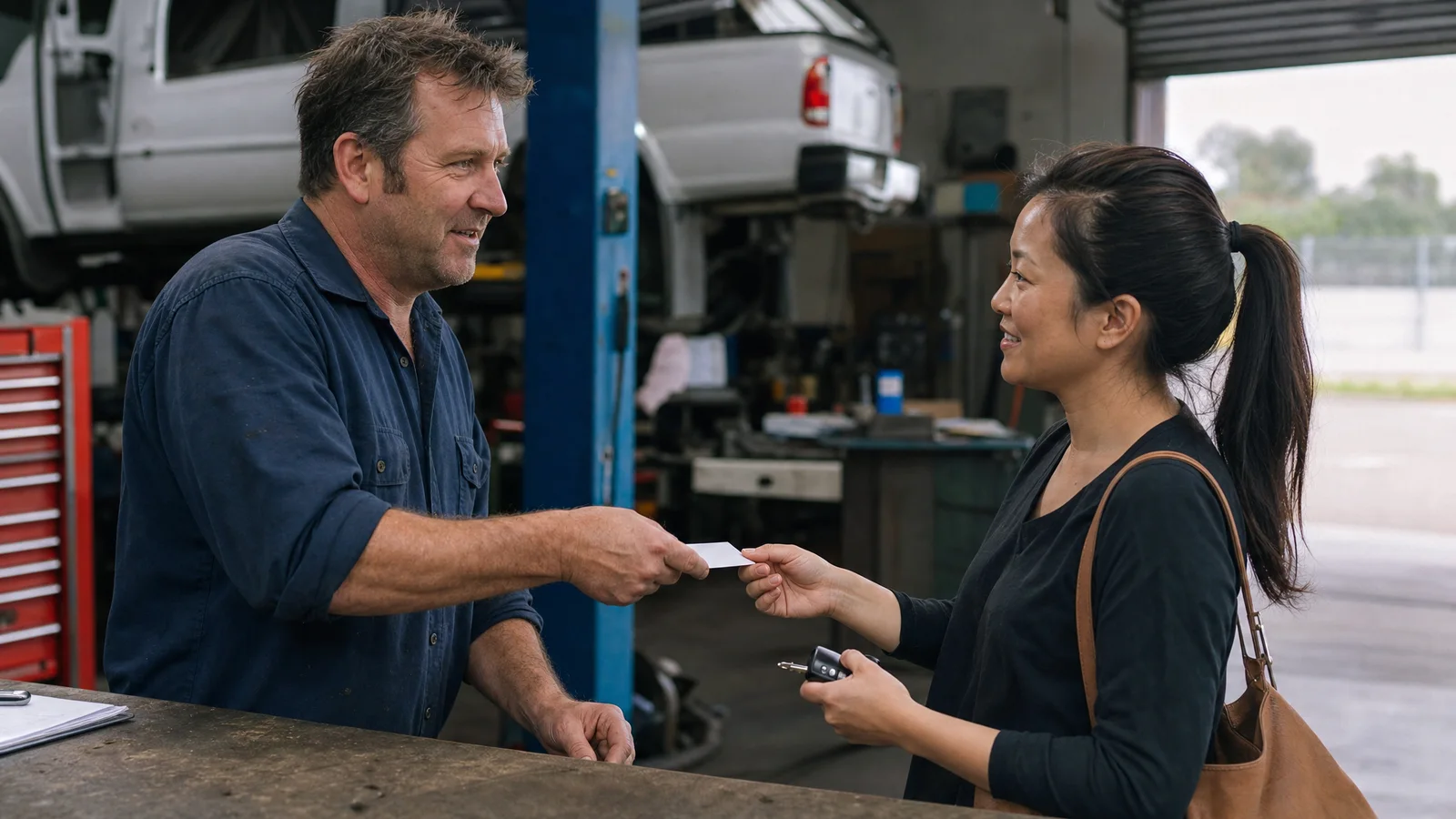
Step one: the card. A printed business card with your name, your number and a QR code on the back that opens your Google review box. You hand it over at the end of the job, the way you'd hand over any business card. "Here's my card if you need anything." The customer sees the QR code, scans it, and the review form is already open on their phone with your business name in it. Google itself recommends exactly this: "To leave reviews, you can ask customers to visit a Google link or scan a QR code."[5] The card just does it without the conversation.
Step two: the text. An hour or a day after the job, a short message with the same link. Something like "Thanks for having us today. If you've got a minute, a quick Google review helps us more than you'd think." The people who didn't scan the card get a second, easy chance, when the job is fresh and the kitchen is clean.
Between them, the card catches the people standing in front of you and the text catches everyone else. A counter poster with the same QR code does the same job for shops and cafes, where the customer is already happy and already standing there. That's the whole system. It costs nothing, it runs on every job, and it doesn't depend on anyone remembering.
We make the card for free. You find your business on Google, we build the card as a print-ready PDF with your QR code on it, and you download it. If you'd rather not deal with a printer, we can arrange that too. It's on the free Google review business card page.
Lenora, who runs a practice in regional Victoria, came to us for a website and left with the review page set up as well. From her review:
"Exceptional service and industry knowledge! Tamhas delivers easy-to-understand explanations and instructions on how to set up my Google Review page online as well as my WordPress Website build and maintenance. Tamhas, at Boostable Marketing, doesn't give you a one-off service then forgets about you!"
Lenora Ah Sue-Prosser ★★★★★ Verified Google review
What to do with a bad review
Every business that trades long enough gets one. The bad review is not the problem; the silence under it is.
Google says your replies "are public and help you build good relationships with customers," and it suggests replying where you can "share a helpful update or answer a question" rather than pasting the same line under everything.[5] The reply is not for the person who complained. It is for the next fifty people who read it while deciding whether to call you. They want to see that you're calm, that you take responsibility where it's yours, and that you'd fix a problem if they had one.
Keep it short. Thank them, say what happened in one sentence if it's fair to, say what you've done about it, and offer to sort it out directly. Don't argue and don't write an essay. A two-line reply from a business owner who clearly cares does more for you than the four-star average it sits under.
Whatever you do, don't try to make genuine negative reviews disappear. The ACCC says businesses must not "suppress or edit negative reviews" or "remove genuine reviews that are negative."[6] And the research says a mix is more convincing anyway: Google notes that "a mix of positive and negative feedback often feels more trustworthy,"[5] and Pew found 48% of review readers already believe "it is often hard to tell if online reviews are truthful and unbiased."[2] A profile with one honest three-star and a good reply under it is proof the rest are real.
- Open your Google Business Profile and check the date of your latest review. If it's months old, that's the problem to fix first.
- Reply to every review that doesn't have a reply. Two lines each. Start with the negative ones.
- Make your review card and put a stack in the van, the ute or at the counter.
- Add the review link to the text you already send after a job. Same message, every job.
- Check your profile categories and services match what you actually do. Reviews lift a relevant profile, not a vague one.
Reviews are what AI search reads, too
More and more people now ask an AI assistant "who's a good plumber in Frankston?" instead of typing it into Google. Those assistants don't have opinions of their own. They read what's already written about you, and the largest pile of writing about most small businesses is their Google reviews. A profile with a hundred reviews that name the jobs and the suburbs gives an assistant something to quote. A profile with four reviews from 2021 gives it nothing, so it recommends someone else.
This is the same advantage as the map pack, one layer up. The businesses collecting reviews steadily today are the ones the next generation of search will have something to say about.
The short version
Google reviews for business do two jobs at once. They lift you into the map pack, because Google counts them as prominence,[1] and they get you chosen once you're there, because 82% of customers read them[2] and buy far more readily from a business that has them.[3] Every extra star is worth real revenue to an independent business.[4]
Most businesses stall because asking is awkward and the customer has to work too hard. A card at the end of the job and a text afterwards fix both, legally, and keep the reviews arriving week after week. Set it up once and it runs on every job you ever do.