SEO for Tradies: How Star Building Inspections Hit Page One
SEO for tradies, shown on a real business. A Hoppers Crossing building inspector went from a brand-new name with no online presence to page one of Google, then 4.7x the clicks when the content engine went on. Here is exactly what was built and why it worked.

By Boostable · 13 September 2026
Websites and SEO for Australian businesses · ~13 min read


Michael had spent years inspecting houses for the big firms. He knew the trade inside out: what a cracked slab means in the western suburbs, which roof tiles fail first, what a termite trail looks like behind a skirting board. What he didn't know was how to get found by a stranger in Hoppers Crossing at 9pm on a Tuesday, with a contract in front of them and a cooling-off period ticking.
That is the whole problem with SEO for tradies. The skill is real and the demand is real, and Google sits between the two doing nothing for you until you give it something to read. In 2021 Michael went out on his own as Star Building Inspections, with his name on the sign and no online presence at all. This is what we built, what he did, and what the numbers look like five years on.
It's a useful story because nothing in it is clever. Every piece is something any tradie in Australia can have, and most of your competitors still don't.
The problem: a brand-new business and zero online presence
A building inspection is bought under pressure. The buyer has found a house, the vendor wants an answer, and there's a window of a few days to get someone through it. So the customer does what everyone does now: they pick up their phone and type "building inspector near me" or "building and pest inspection Point Cook". Google shows three businesses in a map, then a list. They ring the first one that looks trustworthy and answers.
In 2021, Michael wasn't in that map. He wasn't in the list either. He had a name, a ute, a licence and twenty years of knowing what he was looking at, and none of it existed anywhere Google could read.
He is not unusual. There are 2.66 million small businesses in Australia, 97.3% of all businesses, and 64% of them are one person with no employees.[3] Most of them are run by someone who is very good at the work and has never had a reason to think about how Google decides who shows up. That's not a character flaw. It's just not in the training manual.
A homeowner searching at 9pm gives a search result about three seconds. If you're not in the map or the first few results, you don't exist for that job. Being excellent at the work only matters once you've been found.
How Google decides which tradie to show
Google is unusually plain about how the map works. It says local results are ranked on three things: relevance, distance and prominence. Relevance is how well your profile matches what someone typed. Distance is how far you are from them. Prominence is how well known you are, and Google says it considers "how many websites link to your business and how many reviews you have," adding that "more reviews and positive ratings can help your business's local ranking."[1]
Read that as a checklist and SEO for tradies gets simple. You can't move distance. You can make yourself relevant by telling Google exactly what you do and where. And you can build prominence by collecting reviews and having a real website that other pages point at. Everything we built for Star maps onto one of those three.
What we built: three plain things
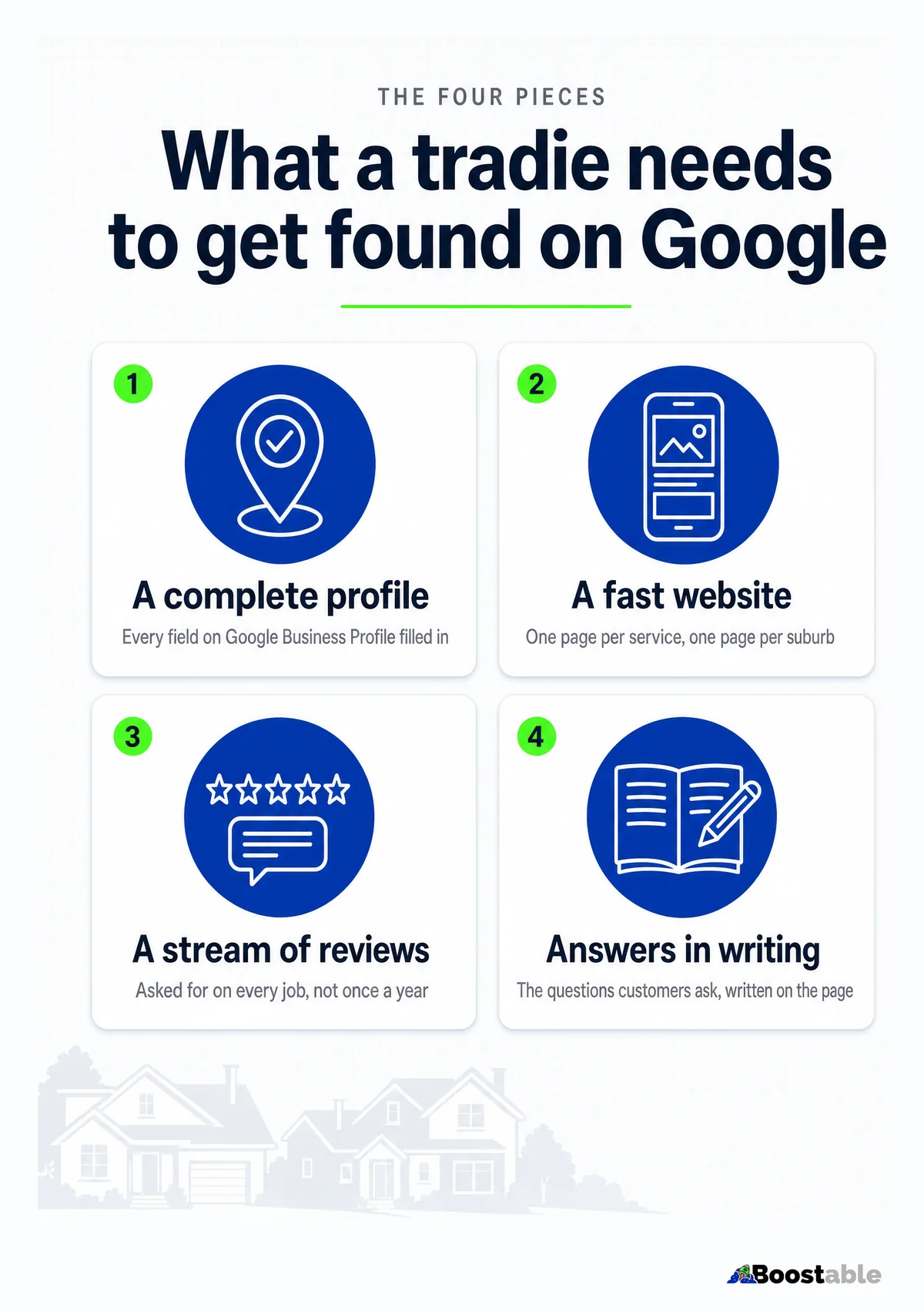
Nothing clever. Three things, in this order.
A verified Google Business Profile
Claimed, verified, and filled in completely: categories, services, hours, phone, photos, service areas. This is the listing that shows in the map, and Google confirms adding and verifying it is free.[2]
A straight website
Fast, clear, built for a phone first. What he does, where he does it, and the phone number at the top and the bottom of every page. No slideshow, no jargon.
A page for each suburb
Hoppers Crossing. Werribee. Point Cook. Each one written in plain English for the homeowner in that suburb: what to expect, what it costs, how soon he can get there.
The suburb pages are the part most tradies skip, and the part Google leans on hardest. Google doesn't know your trade. It reads your site and your profile and decides what you do and where based on what's written there. If Werribee isn't written anywhere on your site, you are not a Werribee building inspector as far as Google is concerned, whatever your ute says.
One warning here, because it's where a lot of tradies get burned. A page per suburb means a real page per suburb, written for that place. It does not mean 200 copies of the same page with the suburb name swapped. Google recognises that pattern and quietly ignores most of it. Three honest pages beat two hundred templated ones.
What Michael did next: the habit that made it work
This is the part most business owners skip. Michael didn't.
Every job he finished, he asked the customer for a Google review. Politely, no pressure, just a short message after the report went out. Most said yes, because he'd done a good job and been straight with them, and people want to help when you ask plainly and make it easy. Google's own guidance is exactly this: ask customers, and give them a link or a QR code so it takes one tap.[7]
Ten reviews in the first few months. Twenty. Fifty. All five stars. Today Star Building Inspections has passed 150 five-star Google reviews, and they keep arriving, because the ask is built into every job rather than remembered occasionally.
Why does that matter so much? Two reasons, and both have numbers behind them. First, Google counts reviews as prominence, so every review is a small push up the map.[1] Second, the customer reads them. Pew Research found 82% of adults at least sometimes read online reviews before a first-time purchase, and 40% always or almost always do.[4] A building inspection is a first-time purchase for nearly everyone who buys one.
Northwestern University's research found purchase likelihood with five reviews is 270% higher than with none, and that the benefit of each extra review "begins diminishing rapidly after the first five."[5] In other words, the first five take you from unknown to safe. Harvard's Michael Luca found each extra star is worth a 5 to 9 percent lift in revenue, and that the effect is "driven by independent" businesses rather than chains.[6] A one-man inspection business is about as independent as it gets.
Michael's own review of us, from the year he started, says more about how the relationship worked than we could:
"I was looking for a website company to help me with my new business set up when I came across Boostable Marketing Agency. I rang Tamhas and basically told him what I was doing and what I needed. Within minutes of chatting I knew I had the right guy. From the our first conversation, Tamhas has been unbelievably dedicated in helping me get my website perfect. His experience, professionalism and friendly nature has made my experience dealing with him a pleasure. The great thing is you know who you're dealing with, Tamhas, not hand-balled across the office. I have recommended Tamhas to friends who are now clients and would totally recommend him to anybody looking to set up a website or updated an existing. Thanks Tamhas you're a champ."
Michael Tuder, Star Building Inspections ★★★★★ Verified Google review
The result, part one: page one
Within the first few months, Star Building Inspections was on page one of Google for building inspections across the western suburbs, and in the map for the suburbs he'd written pages for. The phone started ringing from people who had never heard of him. That was the whole point, and for a while that was the whole story.
The website did what a website is supposed to do: it was the front door for people who searched. The profile put him in the map. The reviews made him the safe choice once he was there. Three pieces, each doing one job, and none of them working without the other two.
Want the same three pieces for your trade? The review system is free to set up.
Get the free review systemThe result, part two: what happened when the content engine went on
Page one is not a finish line. Over 2025, Star's impressions in Google drifted down month by month, from about 34,000 a month in May to under 14,000 by December, as newer competitors filled in their profiles and Google had less and less fresh to read from Star's site. Good traffic and good reviews, but the business couldn't consistently break back through. That's the normal life of a small site that isn't publishing.
In May 2026 we turned the content engine on: a proper page for every suburb Michael covers, and a steady run of articles answering the questions Melbourne home buyers actually ask, from reactive clay soils in the west to what an inspector actually checks. Close to forty new pages, each one interlinked to the others and to the service pages, published on a schedule rather than in a lump.
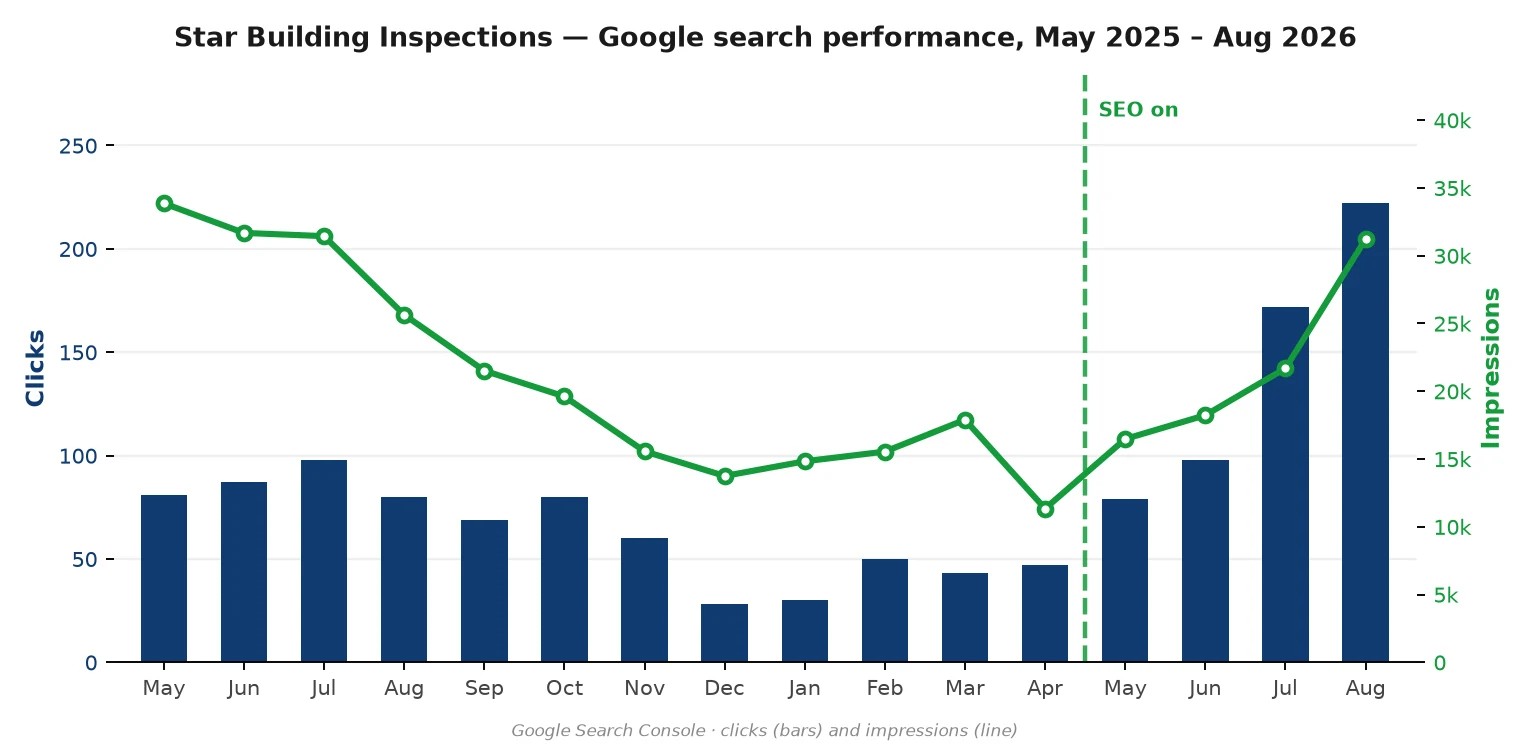
The chart is straight out of Google Search Console. Measured from April 2026, the last full month before the engine went on, to August 2026:
Two things worth noticing. The lift didn't come from the profile or the reviews changing; those were already good. It came from giving Google forty more pages of real, specific, local content to read and rank. And it compounded month on month rather than jumping once, because a steady publishing schedule reads to Google as a live business, not a one-off campaign.
Why it worked, and why it will work for your trade
Every step above answers one of the three questions Google needs answered before it will show a tradie to anyone.
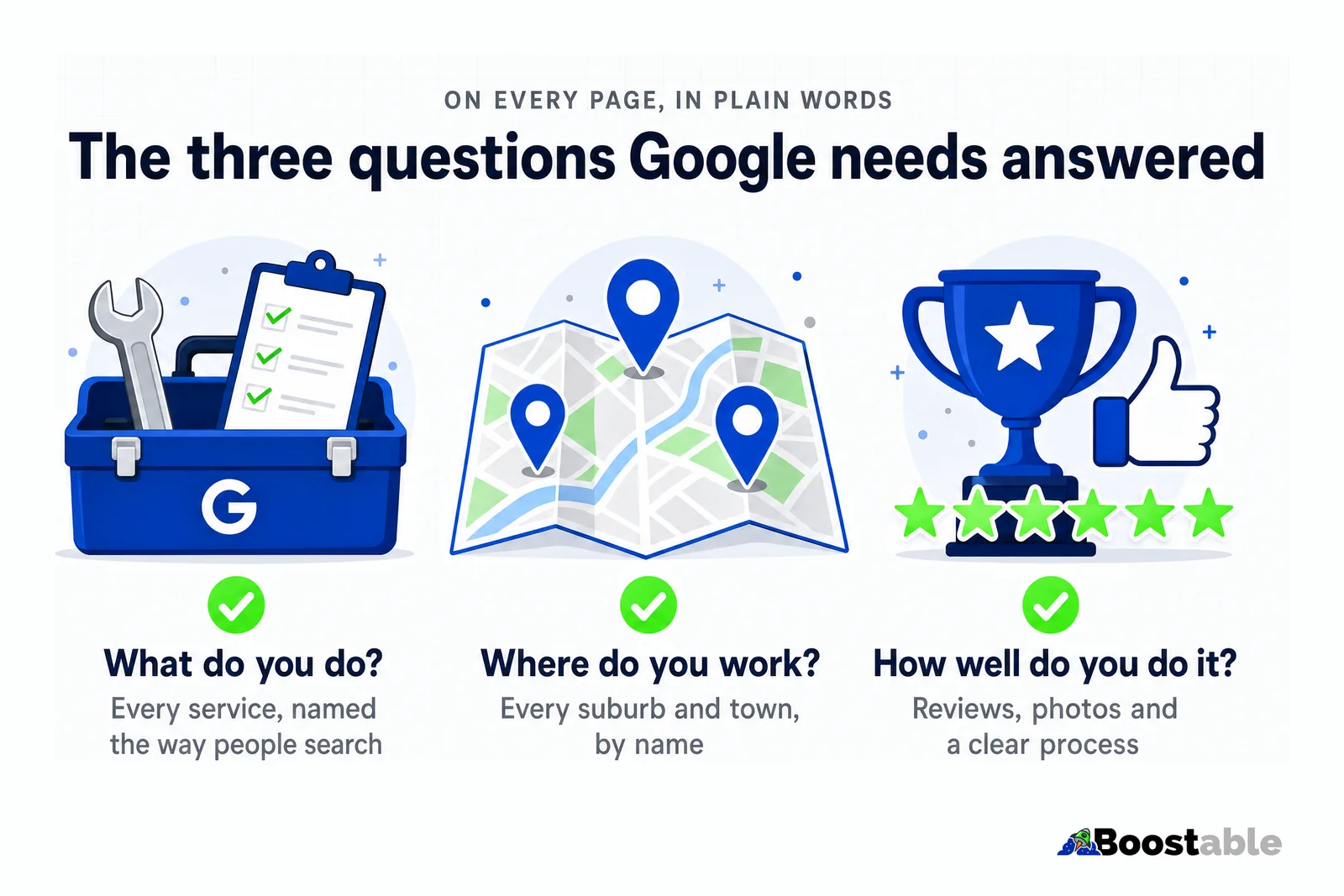
| Google's question | Where the answer lives | What Star did |
|---|---|---|
| What do you do? | Profile categories and services, service pages on the site | Building, pest and pre-purchase inspections, each named the way buyers search |
| Where do you work? | Profile service area, a page per suburb | Hoppers Crossing, Werribee, Point Cook first; every western suburb once the engine went on |
| How well do you do it? | Reviews, photos, replies, a clear process | Asked every customer, every job; 150+ five-star reviews |
| Are you still active? | Fresh pages, fresh reviews, fresh photos | A publishing schedule from May 2026, and reviews still arriving weekly |
Here's what the same approach looked like for a small service business in Wollongong that found us through a client's footer:
"I run a small service business. I was not doing well on google. While looking at someone else's website who ranked really high, i found Boostable Web Design & Digital Marketing's logo at the bottom of the page.. so i called Tamhas. From my initial phone call, it was obvious he had full knowledge of local SEO. He was & still is so helpful. He's energetic and is as keen as i am at getting results. The first day i was verified on GMB after he tampered with it, i got a call from a customer that turned into a job the same day. Boostable is well worth the money."
Joely boy, Wollongong ★★★★★ Verified Google review
A call that turned into a job the day the profile was verified. That's the profile doing the relevance and distance half of Google's checklist on its own. The reviews and the pages do the prominence half, and that's the half that keeps you there.
The quiet truth about SEO for tradies
Nobody in Michael's story did anything a competitor couldn't have done. He filled in a free profile. He asked for reviews. He had a site that said, in plain English, what he did and where. Later, he let us keep publishing pages that answered his customers' questions.
Most tradies don't do those things, not because they can't, but because they're on the tools all day and the website is the thing they'll get to next month. That's the gap. You don't have to be the biggest inspector in Melbourne, or the cheapest. You have to be the one Google can read, in the suburbs you work in, with the reviews to prove it. Do the basics a bit better than the other bloke and that's usually enough to be the one who gets the 9pm call.
✓ The ones who get found
- Profile 100% complete, every service listed
- A real page for each suburb they work in
- Ask for a review after every single job
- Reply to reviews, good and bad
- Keep adding pages that answer customer questions
✗ The ones who stay invisible
- Profile claimed in 2019 and never touched
- One "Areas we service" page listing 40 suburbs
- Nine reviews, the newest from two years ago
- A site that says "quality workmanship" and nothing specific
- Nothing new published since the site went live
- Search your own trade and suburb on your phone. If you're not in the map, that's the first job.
- Open your Google Business Profile and fill in every field: services, categories, hours, photos, service areas.
- Set up the review card and ask after every job, starting with the one you finish today.
- Make sure your website names every service and every suburb you actually work in, on its own page.
- Call us. We'll show you where you sit against the tradies beating you, and what it would take.
Michael's an inspector. He wanted to inspect houses, not learn search engines. He gave Google what it needed to read, kept asking for reviews, and let the pages do the rest. Five years on, the phone still rings from people who've never heard of him. That's what SEO for tradies is supposed to look like.