
SEO for Tree Services: What One Page Did for G&J Tree Services in Wangaratta
SEO for tree services, shown on a real business. What we built for G&J Tree Services in Wangaratta in 2025, where they show on Google today (checked September 2026, positions included), and what a single page could and couldn't do.

By Boostable · 13 September 2026
Websites and SEO for Australian businesses · ~11 min read


G&J Tree Services run a proper outfit out of Wangaratta. Qualified arborists, rural land work, fire trail clearance, forestry mulching, dam desilting, a firewood yard. When they came to us in mid-2025 they had all the kit and all the skill, and no Google ranking for any of it. This post is what SEO for tree services looks like on a real business: what we built, what Google shows for them today, checked on 13 September 2026 with the positions written down, and the honest gap between the two, which is the most useful part.
We're publishing the current numbers rather than a "page one in weeks" headline because that's what you'd want to see before hiring anyone: where the business actually is, more than a year on, and what the next job is.
- Local SEO with Boostable: the interview, the profile, the town pages and the reviews, done for you.
- Local SEO for small business: how to actually get on page one
- SEO for tradies: how Star Building Inspections hit page one
- List your service areas and get found on Google
The problem most country businesses have
Search "tree removal Wangaratta" in early 2025 and G&J didn't appear. Not on page one, not on page two. Not because the work wasn't good; the work was excellent. Google simply had no idea they existed. The website said almost nothing. The Google Maps listing was half-built. The towns they drove to weren't written down anywhere a search engine could read.
The phone rang when someone asked a mate. It didn't ring when someone searched Google. Word of mouth is fine, until the next generation of property owners starts typing instead of asking their dad. And in a region where nearly every business is a small one (97.3% of Australian businesses are small businesses[8]), the competitors in the map box are other small outfits who happened to fill in the form.
Google is clear about what it's doing with those searches: "many queries have a local intent. So when you search for 'pizza', you get results about nearby businesses that deliver."[2] Tree removal is about as local as intent gets. If Google can't read where you work, it can't show you to the people there.
How we started: the interview
First thing we did was ring them. A proper forty-minute conversation. We asked what they actually did, the real version rather than the marketing version. The rural properties they look after. How they handle council and civil jobs. What they do on bushfire-zone land. The machines they run. How they get a tricky stump out from between a dam and a fence line.
None of that was on the website. All of it went on after the call. Google's own guidance asks whether content "clearly demonstrate[s] first-hand expertise and a depth of knowledge (for example, expertise that comes from having actually used a product or service, or visiting a place)."[3] An arborist who's spent fifteen years on the tools has more first-hand expertise than any copywriter. The interview is how we get it out of their head and onto the page in their own words. We do it for every client.
The questions are not clever. What do you do, and what are all the variations of it? Which jobs do you get asked for most, and which ones do you wish you got asked for more? Where do you actually drive to, town by town? What does a customer worry about before they ring, and what do you say to settle them? What goes wrong on this kind of job when a cheaper operator does it, and what do you do so it doesn't? What kit do you own that the bloke down the road hires in? Every answer is a paragraph on the page. Forty minutes of talking produced more usable, specific, true material than a month of guessing would have, and it's the reason the page reads like a tree business rather than a template.
What we built
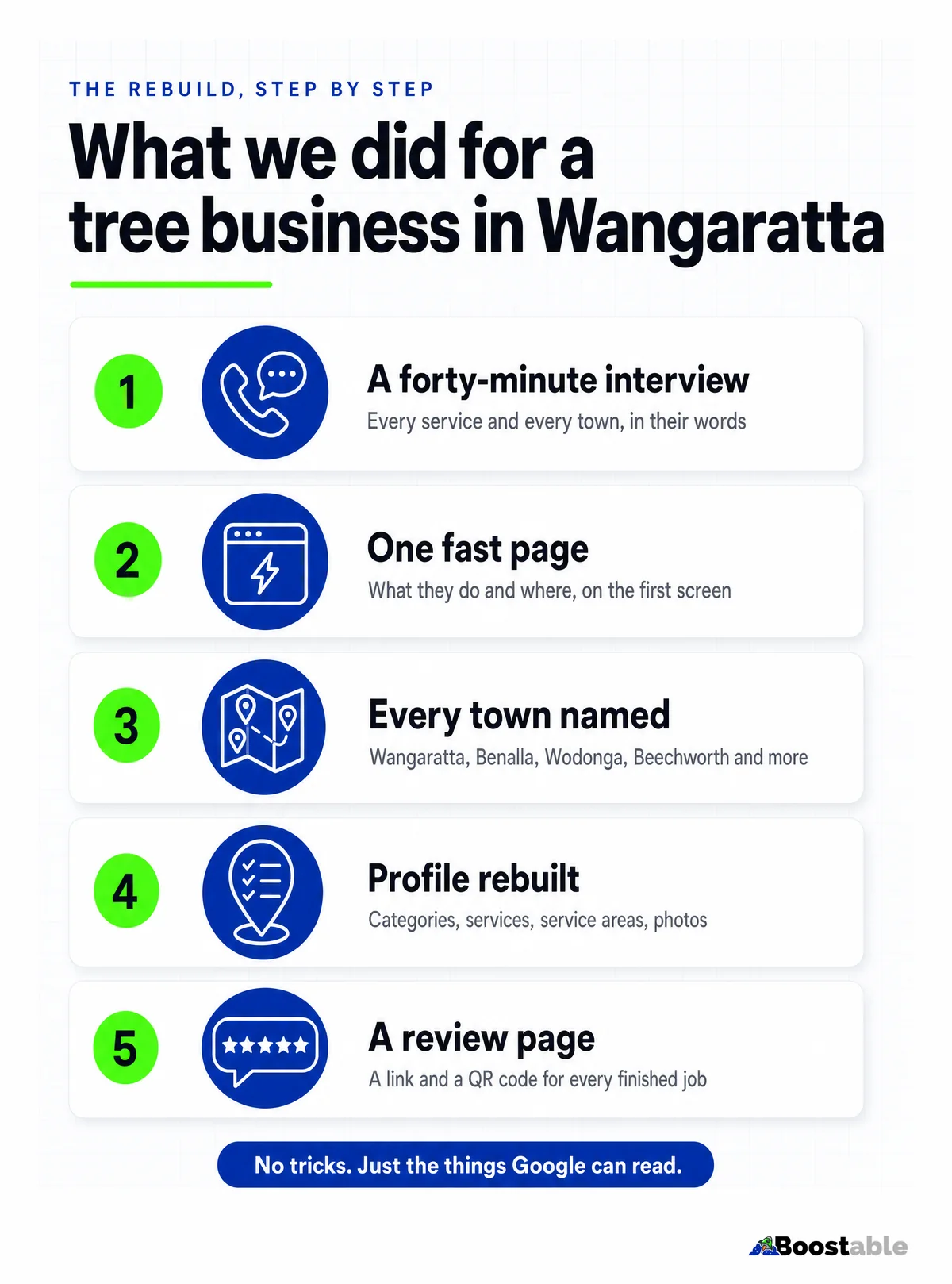
One fast page. Not a sprawling site. A single long homepage that shows what they do and where they work inside the first screen, then walks through every service in the detail a customer wants before they ring: arborist and tree services, vegetation management and fire trails, forestry mulching and excavator work, equipment hire, dam cleaning and construction, the firewood and mulch yard. About two thousand words, in their words.
Every town named. Wangaratta, Benalla, Beechworth, Myrtleford, Wodonga, Albury, Shepparton, Seymour, Mansfield, Yarrawonga, Corowa, Wagga Wagga and the rest, written on the page so Google could read them. Google's ranking explainer says the most basic relevance signal is when "content contains the same keywords as your search query," particularly "in the headings or body text of a webpage."[2] If the town isn't on the page, there's nothing to match.
The Google Business Profile rebuilt. Every service field filled. The categories chosen carefully. Service areas set for the towns they actually travel to (Google allows up to 20, within about two hours' drive[5]). Google's advice is blunt: "businesses with complete and accurate info are more likely to show up in local search results."[1]
A review page. A page on the site that takes a customer straight to the Google review box, with a link for the text after the job and a QR code for the card. Google suggests exactly this: "ask customers to visit a Google link or scan a QR code."[6]
What do you do?
Every service, named the way a customer would search for it. "Stump grinding", not "site remediation solutions".
Where do you work?
Every town and district by name. Not "north-east Victoria". Benalla. Beechworth. Myrtleford.
How well do you do it?
Photos of real jobs, reviews, a clear process, the detail an owner wants before they pick up the phone.
The page itself follows a pattern we use on every trade site, and it's worth spelling out because it's the part that makes the interview worth doing. For each service there are three things written down. What the job involves, in plain words. How G&J do it well: the machines, the sequence, the safety steps, the way a fire trail gets cleared so it stays cleared. And what goes wrong on this kind of work when it's done cheaply, and what they do so it doesn't. That last part is what a property owner is actually worried about, and almost no tree business writes it down. Google's guidance calls this people-first content, "created primarily for people, and not to manipulate search engine rankings,"[3] and the reason it ranks is that it's the page a nervous customer wants to read.
Anyone can say they're the best. Specifics prove it. "We chip on site and leave the mulch if you want it, or take it to our yard" tells a customer more than "professional, reliable service" ever will, and it gives Google a hundred more words about tree work to match against.
"The Foot Centre, Wangaratta just wanted to thank Tamhas for his fast, friendly service and his knowledge on all things websites. Tamhas created a new website for us which looks great, is fast and easy to navigate. Explainer videos for updating information were also sent and were easy to understand and follow. Tamhas also increased our Google presence. His follow up service was great ensuring we were happy with how the website was running and also making sure we were comfortable with using and updating the website."
Jo Direen ★★★★★ Verified Google review
Where they show on Google today
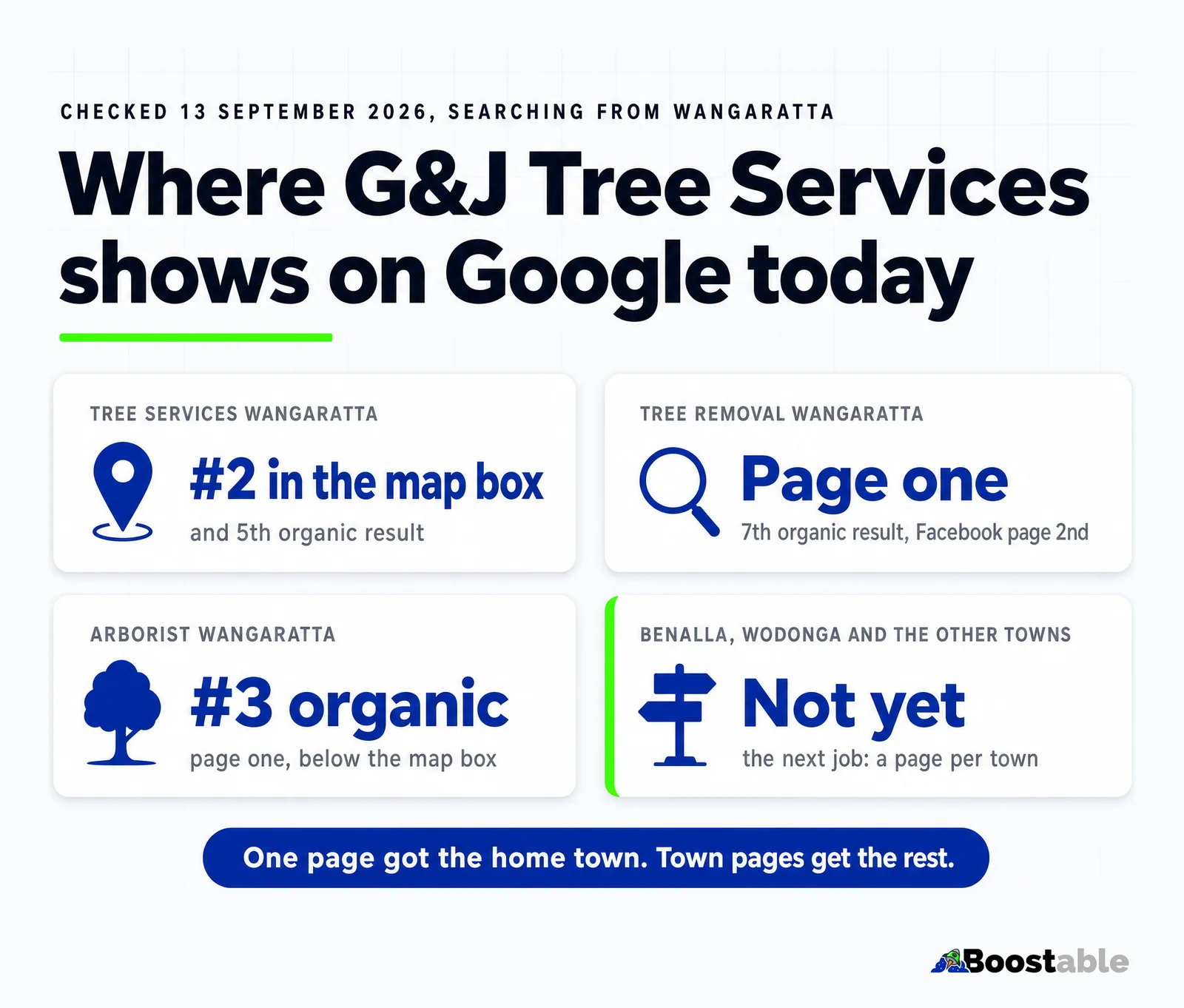
Rather than repeat what happened in the first few weeks, here is what Google returns now. We checked on 13 September 2026, on a phone, searching from Wangaratta, which is how their customers search.
| Search | Map box | Organic results |
|---|---|---|
| tree services wangaratta | 2nd of 3 (12 reviews) | Website 5th, Facebook page 2nd |
| tree removal wangaratta | Not in the box | Website 7th (page one), Facebook page 2nd |
| arborist wangaratta | Not in the box | Website 3rd (page one) |
| tree removal benalla | Not showing | Not showing |
| tree removal wodonga | Not showing | Not showing |
So: from nowhere to page one for all three of their core home-town searches, and into the map box for one of them, on the strength of a single page and a filled-in profile. That's the good news, and it's real. Anyone can run the same searches and see it.
The other half of the table is just as instructive. For Benalla and Wodonga, the towns G&J happily drive to, the site doesn't show at all. Naming a town once on the homepage was enough to be honest with Google about the service area. It was not enough to rank there. That's the part most agencies leave out of the case study.
One more detail from the table. For "tree removal wangaratta", G&J's Facebook page ranks second, above their own website at seventh. That isn't a problem; it's Google treating the Facebook page as another page about the business and finding it a good match. It does tell you two things. Google will happily rank whatever it can read about you, so a page you post to every week is worth keeping. And the website has room to move up: a page on the site that's specifically about tree removal, rather than a homepage that covers six services, is the obvious next step for that search.
What one page can and can't do
One page, done properly, gets you your home town. It can't get you twenty towns, because Google matches searches to pages, and a page about "tree services in north-east Victoria" isn't a page about tree removal in Benalla. Google's starter guide says to "think about the words that a user might search for to find a piece of your content"[4]; a Benalla property owner types "tree removal benalla", and the page that ranks is the one that's actually about that.
The town in the heading and the first paragraph. The services offered there, in the same words as the home page. Something true and specific about working in that town: the soil, the fire zone, the council, the drive time, a job done there. A photo from a job there if one exists. A phone number and the review link. Four or five hundred honest words is plenty. Twenty copies of the homepage with the town name swapped is not a town page, and Google can tell.
The map box is the other lever. G&J sit second in it for "tree services wangaratta" with 12 reviews; the business in first has 62. Google says prominence is "based on info like how many websites link to your business and how many reviews you have," and that "more reviews and positive ratings can help your business's local ranking."[1] Northwestern's Spiegel Research Center found purchase likelihood with five reviews is 270% higher than with none.[7] The review page exists. The habit of asking on every job is what fills it.
✓ Delivered
- Page one for "tree removal wangaratta", "tree services wangaratta" and "arborist wangaratta"
- Second place in the map box for "tree services wangaratta"
- Every service written down in the owner's words
- A profile Google can match to the searches
- A review page ready for every finished job
✗ Still to do
- A page for each outlying town: Benalla, Wodonga, Beechworth, Myrtleford and the rest
- Close the review gap on the business in first place (62 to 12)
- Real job photos added regularly, and a short post most weeks
- The map box for "tree removal" and "arborist", not just "tree services"
The review gap is the cheapest one to close. The card and the text that do it are free.
Get the free review systemWhy this applies to most rural businesses
If you're a tradie, a transport operator, a cleaner, a rural contractor, this exact sequence works for you, and the gap it leaves is the same one. Most of your competitors haven't filled in their Google profile properly. Most don't name their towns. Most don't ask for reviews. Google says there's "no way to request or pay for a better local ranking,"[1] which means the business that gives Google the most to read wins, and in a regional town that bar is low.
Two mistakes we see every week in country towns. They list one town. "Wangaratta tree service." Then they wonder why nobody from Benalla calls. Google only showed them to Wangaratta because that's all they mentioned. They never ask for reviews. Ten years in business, four reviews, all from 2017, while the new operator up the road has fifty after six months. Both are fixable. Both are fixed fast.
"Tamhas has been amazing. He not only built my website but helped me create a successful business online. He is dedicated and always willing to help. Tamhas has been doing work for us since 2014 and we could not be where we are without him and his wizard like website skills. Thanks mate your not only great at your job but a top quality guy. Perth Fence ;)"
Perth Fence ★★★★★ Verified Google review
The order we'd do it in, for any tree business
The G&J sequence is the sequence. The only thing we'd add now is the town pages, and we'd add them sooner.
- Search your main service and your town on your phone. Note who's in the map box and how many reviews they have. That's your target.
- Sit down for forty minutes and talk through every service and every town you work in. Record it. That's your website copy.
- Claim and verify the Google Business Profile, then fill every field: categories, every service, every service area, real photos.
- Put every town on the website, then build a page for each of the ones that matter most, starting with the nearest.
- Set up the review link and the card, and ask on every finished job. Reply to every review.
From hidden to page one in the home town didn't take long for G&J, and it won't for you. Getting the towns around it is the next page, and the next one after that. If you'd rather we wrote them, that's what our local SEO service does. Every position in this post came from a live search on the date shown. Run the same searches yourself before you take our word for it, and run them again in a month.


