Can You Remove a Google Review? What Google Will and Won't Take Down
What actually gets a Google review removed: Google's real policy, how to report one, when a solicitor's letter can help, and why more real reviews beat chasing the odd bad one.

By Boostable · 17 September 2026
Websites and SEO for Australian businesses · ~14 min read

Typing "how to remove a Google review" into Google is usually the second thing an owner does after reading a bad one, right after the sinking feeling. The honest answer is that Google removes very few reviews, and almost never because they are unfair. It removes reviews that break its rules, and it leaves alone reviews that are simply negative, because a bad experience is not a policy violation, it is an opinion Google is built to show.[2]
We build the review systems for small businesses across Australia, so we get this question from clients constantly: can you get rid of this one, can you get rid of that one. Below is what actually gets a review taken down, what does not, the reporting process step by step, when a solicitor's letter is worth it, and what the Australian Consumer Law says about a business's own conduct with reviews. Then the part that matters more than any of it: what to do instead, because it works better and it is inside your control.
If you already know the short answer and just want the fix, skip to the bottom. If you want to understand what you are dealing with first, start here.
Two related searches usually sit right behind this one: "fake google reviews" and "report google review". They are really the same question asked from different sides. Someone who suspects a review is not genuine wants to know how to report it and what Google actually checks. Someone who has just been hit with one wants to know how fast it can come down. Both answers are the same policy, read from opposite ends, and both are below.
- Get Reviews: the free two-step system that gets more real Google reviews without anyone having to ask twice.
- The power of Google reviews: how to use client reviews to grow your business
- Why most review strategies completely miss the point
What Google will actually remove
Google's content policy for Maps and Search reviews sets out specific categories, and a review has to fall into one of them.[1] The two categories that come up most for a small business trying to get a review down are these.
Grounds Google will act on
- Fake engagement: the reviewer never used your business, or the review "does not accurately represent" a real visit
- Paid or incentivised reviews, "directly or in kind", including someone offering to make a bad review disappear for a fee
- Conflict of interest: an employee, competitor or someone connected to the business reviewing without disclosing it
- Off-topic content: it is meant for a different business, a different branch, or has nothing to do with an actual visit
- Harassment, hate speech, sexually explicit or dangerous content, including a review that singles out one staff member by name rather than commenting on the business
- Spam, advertising, or the same review posted repeatedly
Not grounds for removal
- The review is negative, harsh or one-sided
- The rating seems unfair given what actually happened
- The customer was wrong about something minor
- You disagree with the reviewer's opinion of your work
- The review is old and you think it no longer reflects the business
The line Google draws is between what happened and how someone felt about it. A review that says a tradesperson turned up late and the job took two extra days is an opinion about a real visit, and it stays, even if you disagree with the framing. A review from someone who has never set foot in your business, or from your competitor's staff member, is fake engagement, and that is the kind of thing Google's policy is built to catch.[1]
If the review is real and it is on you, the fix is not a report. It is fixing the actual problem. Contact the customer, sort out whatever went wrong, and once they are happy, ask them to update the review. Most people will. A review that says a business turned up and put a mistake right does more for the next customer's confidence than a five-star review with no story in it at all. Chasing a removal for something that genuinely happened just leaves the same problem waiting for the next customer to find.
How to report a review, step by step
If a review genuinely breaks one of the categories above, reporting it costs nothing and takes two minutes.
Open the review
From your Business Profile, go to reviews and find the one you want to report.
Flag it
Click the flag icon or the three-dot menu next to the review.
Pick the policy
Choose the specific reason: spam, fake engagement, conflict of interest, offensive content, and so on. Vague reports get denied.
Wait and track
Google's own guidance is that evaluation typically takes several days.[2] Track it in the Reviews Management Tool: pending, denied, or escalated on appeal.
If the report is denied, you get one appeal. Be specific in it: point to exactly which policy the review breaks and why, rather than restating that it is unfair. A report that says "this customer never bought from us" with a reason attached does better than one that just says the review is wrong.[2]
The reviews that usually are not real
Running review systems for businesses across Australia, the reports that actually work fall into a handful of patterns. If the review you want gone matches one of these, report it properly. If it does not, the honest answer is that it is probably staying up, and the next section covers what to do instead.
Someone offering to remove it for a fee
A message or call offering to "fix" the review, delete it or push it down the page for payment. That is exactly the incentivised-review scenario Google's own policy bans, and it goes the other way too: paying does not make it disappear properly, and it tells whoever is asking that you will pay again.
Wrong business
The review names a different suburb, a different service, or a job you never did. Sometimes it is a genuine mix-up between two similarly named businesses, sometimes it lands on the wrong branch of the same company. Either way it is off-topic, not a real account of your business.
No real connection to the business
The reviewer's profile shows no other activity, or the account cannot be tied to any booking, purchase or enquiry you can find. That is fake engagement, and it is the clearest case to report.
Targeting a person, not the business
A review that names and attacks one staff member rather than commenting on the service is harassment, and Google treats it as its own category. Report it on behalf of the business and the employee both.
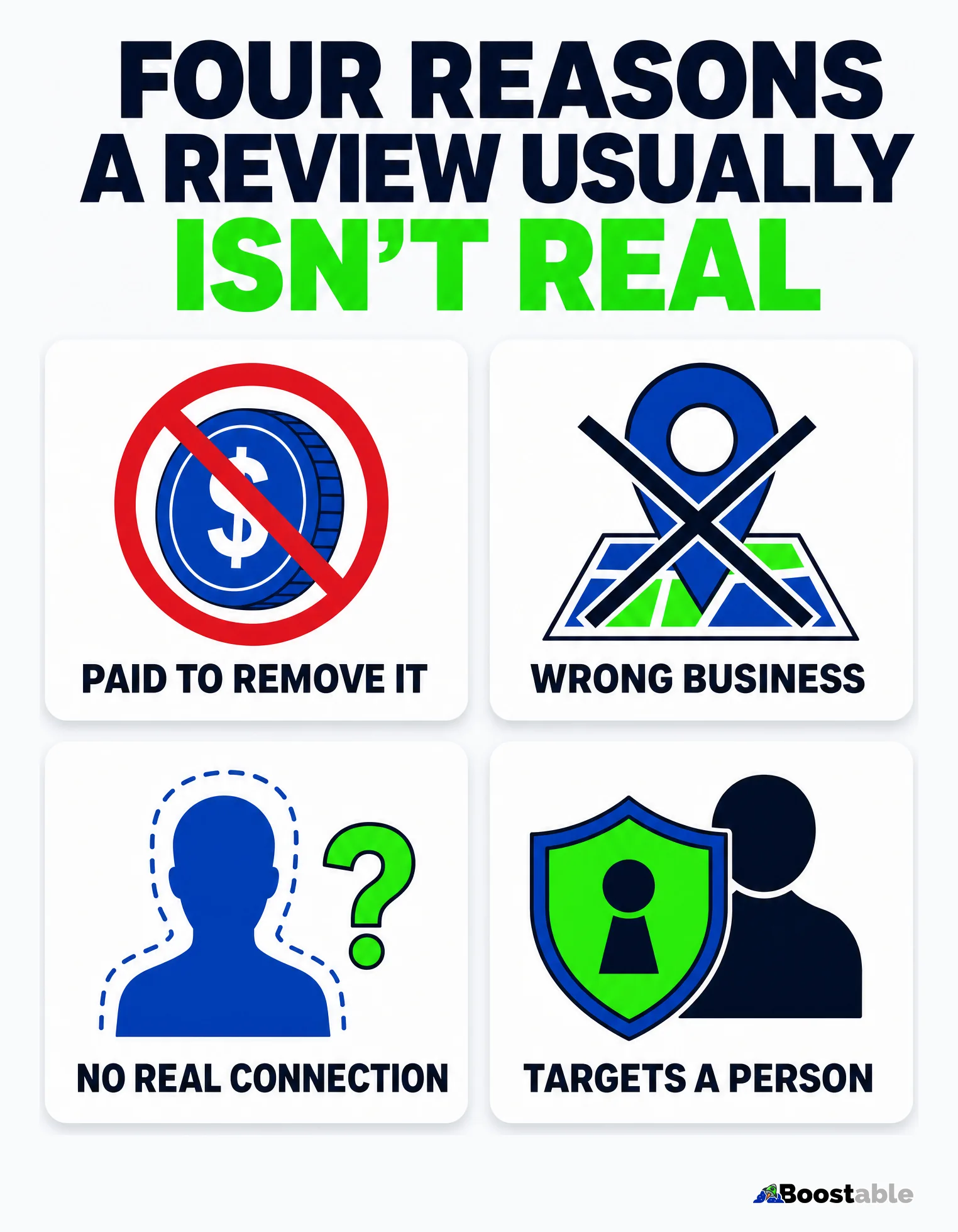
Check first whether it genuinely is one of the four, and that matters more than it sounds. If the review is real, reporting it as fake will not work, and it can cost you more than the one review: an account that reports genuine reviews as fake builds a track record with Google, and that history can make Google slower to act the next time you report one that actually is fake. Save the reports for the ones that genuinely are not real.
When a review is genuinely defamatory
Sometimes a review goes past an unfair opinion into a false statement of fact: an accusation that you did something illegal, invented an incident, or made a specific claim that is simply untrue and damaging. That is a different problem to a harsh star rating, and Google treats it differently too, through a separate legal removal process rather than the standard content-policy report.[3]
Google's legal removal troubleshooter asks for either a court order finding the content unlawful, or a sworn statement that the review is defamatory under the law where you operate.[3] In practice that usually means involving a solicitor: a formal letter to the reviewer, and if it goes further, a defamation claim. This is worth doing properly rather than firing off the online form yourself, because the bar is real. A review that says "the tiles started lifting after six months" is an opinion about your work, even a wrong one. A review that says "they never turned up and kept my deposit" when you have the job photos and the receipt showing otherwise is a specific, false, damaging claim, and that is what the legal path exists for.
Most Australian states also have simpler, cheaper options before a full defamation claim: a solicitor's letter asking the reviewer to correct or remove the specific false claim often works on its own, because most people did not expect a legal letter over a Google review and would rather edit it than argue. Keep records as you go, screenshots with dates, any correspondence with the reviewer, and anything that shows the false claim is false: job photos, invoices, appointment records. A solicitor will ask for exactly this, and having it ready is most of the work done before the first phone call.
The other side: what the law says about businesses and reviews
The Australian Consumer Law does not only look at what reviewers post. It looks at what businesses do with reviews too, and the rules cut both ways. The ACCC is plain about it: "It's against the law for a business to create fake or misleading reviews or to arrange for others to do so."[5] That covers reviews from staff, family or paid contributors posted without disclosing the connection, and reviews offered an incentive without that incentive being clearly labelled.[4]
The part that surprises most business owners is the other half of that guidance: deleting or hiding a genuine negative review can be a problem too. The ACCC says businesses "need solid grounds before deleting reviews, as removing genuine negative feedback may itself be misleading."[5] The law is not there to protect businesses from criticism. It is there to stop the picture a customer sees from being manufactured in either direction, fake five stars pushed up or genuine one stars quietly deleted.
None of this is legal advice, and if you are dealing with a review you believe is defamatory or a competitor is manufacturing fake reviews against you, that is exactly the point to talk to a solicitor, not a blog post. What the law does make clear is the easier, cheaper path most businesses actually need: you cannot delete your way to a clean page, and you should not try to. You can only add to it.
"I was looking for a website company to help me with my new business set up when I came across Boostable Marketing Agency. I rang Tamhas and basically told him what I was doing and what I needed. Within minutes of chatting I knew I had the right guy. From the our first conversation, Tamhas has been unbelievably dedicated in helping me get my website perfect. His experience, professionalism and friendly nature has made my experience dealing with him a pleasure. The great thing is you know who you're dealing with, Tamhas, not hand-balled across the office. I have recommended Tamhas to friends who are now clients and would totally recommend him to anybody looking to set up a website or updated an existing. Thanks Tamhas you're a champ."
Michael Tuder ★★★★★ Verified Google review
Want more reviews like that one arriving without having to ask every customer twice? Our free review system does it for you.
Get your free review cardWhen a fake review is aimed at you
Not every removal request is about a genuine customer having a bad day. A good share of what small businesses report is not a real customer at all: a one-star review from an account with no other activity, posted the same week as a falling-out with a supplier, an ex-employee, or a competitor. That is exactly what the fake engagement policy is for, and it is worth reporting properly rather than assuming nothing can be done.[1]
The signals worth checking before you report: does the reviewer's profile show any other reviews, ever, or is this their first and only one. Does the review mention a product, service or visit that does not match anything you actually offer. Does the timing line up with something else, a dispute, a bad reference, a competitor opening nearby. None of that guarantees Google removes it, but a specific report ("this account has no other reviews and no record of a booking or purchase with us") gives the reviewer moderating the case something concrete to check, rather than a general complaint that the review is unfair.
If you run a Google Business Profile for any length of time, expect at least one of these. It is common enough that Google built a standing category for it rather than leaving businesses to argue it case by case.[1] The mistake most owners make is treating a fake negative review and a genuine bad one the same way, firing off the same annoyed reply to both. They call for different responses: report the fake one and say nothing public until it is resolved, and reply calmly to the genuine one because a good reply to real criticism often does more for a future customer's confidence than the review itself does damage.
Why chasing removals is the wrong fight
Say the report gets denied, the review stays, and it genuinely was not fair. Most owners' instinct is to keep fighting it: report it again, argue in the replies, ask everyone they know if there is a way around it. That energy is almost always better spent somewhere else, and the maths explains why.
| Total reviews | One-star reviews | Average shown | What a customer sees |
|---|---|---|---|
| 6 | 1 | 4.2★ | One bad review is a sixth of the page. It is the second thing anyone reads. |
| 25 | 1 | 4.7★ | Still visible, but buried under two dozen good ones. |
| 80 | 1 | 4.9★ | The average barely moves. Most readers never scroll far enough to find it. |
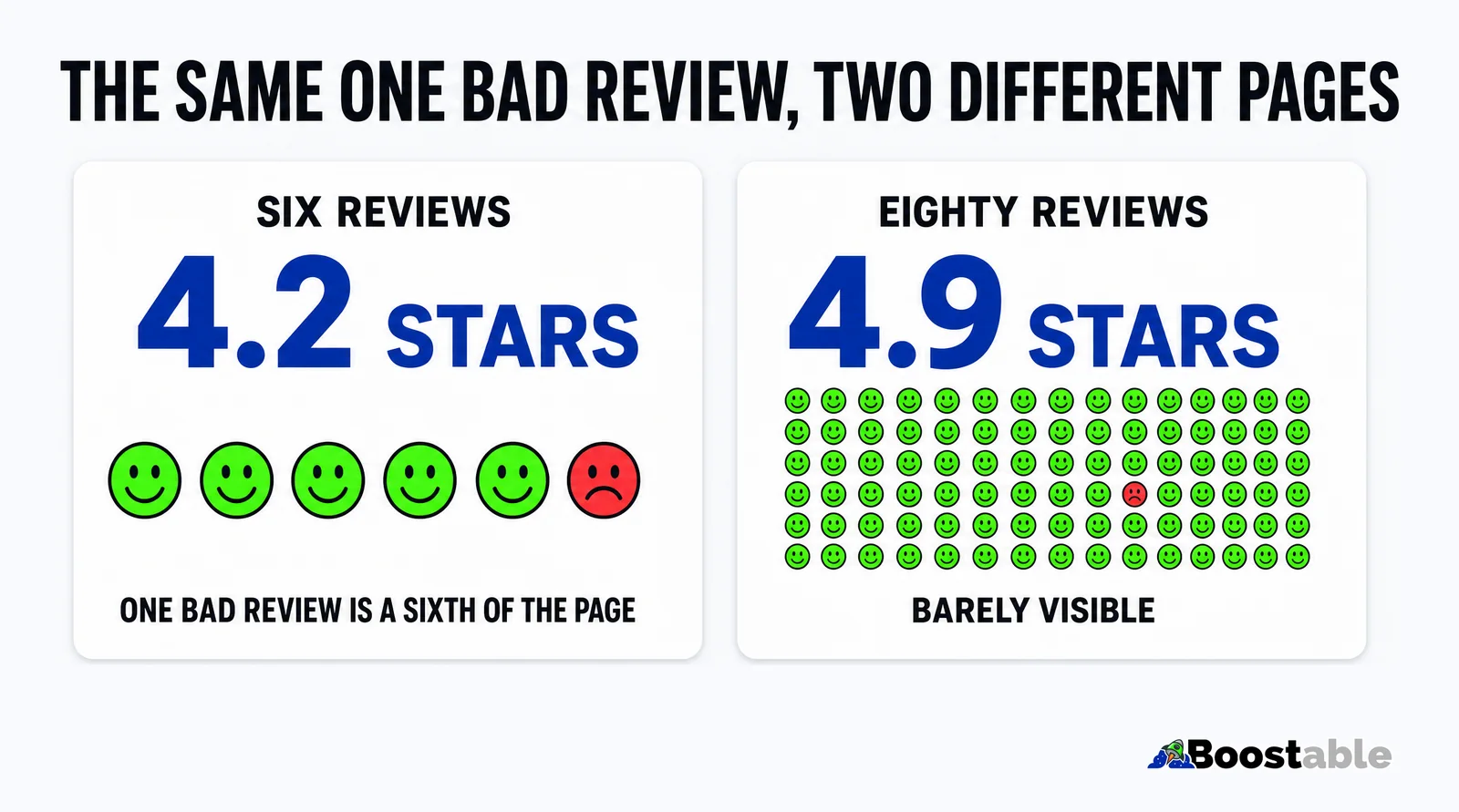
A business with 6 reviews and one bad one is showing a customer a page that is one-sixth negative. The same one bad review sitting inside 80 reviews is barely visible, and the average star rating barely moves. Google and your customers read the average and the count together, not any single review in isolation. The businesses that stop losing sleep over one bad review are, almost without exception, the ones with enough real reviews that one bad one cannot swing the picture.
This is also the more reliable lever. A removal report can be denied, and usually is unless the review clearly breaks a policy. Nobody can deny you asking your next happy customer for thirty seconds of their time. One of those two things is fully in your control, and it is not the one most business owners spend their energy on.
- Report it, once, properly. If it genuinely breaks a policy, use the specific category, not a general complaint, and then let it sit with Google.[1]
- Reply publicly, once. Calm, factual, no arguing. Future customers read the reply as much as the review.
- If it is genuinely defamatory, talk to a solicitor, not a removal service. Get a real read on whether it clears the bar before you spend money.[3]
- Then stop looking at that one review and start asking every happy customer for a review, this week, while the job is fresh in their mind.
- Put a system behind it so asking is not something you have to remember to do. That is the whole point of a review system.
"Our experience was great. Tamhas and his team were responsive, helpful and worked with us every step of the way to create exactly what we needed."
Lindsay Spears ★★★★★ Verified Google review
The short version
Google removes reviews that break its policies: fake, paid, off-topic, a conflict of interest, harassment. It does not remove reviews just because they are negative or unfair, and it says so plainly.[2] A genuinely defamatory review is a different, narrower path involving a solicitor and either a court order or a sworn legal statement.[3] And under the Australian Consumer Law a business cannot fake its own reviews or quietly delete the genuine bad ones either, so the honest path runs the same way it always has: earn the reviews, ask for them properly, and let volume do what deletion cannot.[5]
If the one bad review is the only thing standing between your business and a page that reflects what you actually do, the fix is not a removal request. It is the next twenty real ones. Every one of the reviews quoted on this page came from a real customer who was asked at the right moment, not chased months later when the job was a distant memory. That timing is most of the trick: ask while the work is fresh, make it a thirty-second job with a direct link rather than a search for your business name, and do it for every customer, not just the ones you are fairly sure will say something nice.
Our free review system is built to get those without you having to chase a single customer for it. The card goes in the customer's hand, the poster sits at the counter or in the van, and the follow-up text goes out on its own. No contract, no software to learn, and it keeps running long after the one bad review has scrolled off the first page.