How to Choose an SEO Agency Without Getting Rolled
How to choose an SEO agency, using Google's own advice on hiring one. The four red flags, the questions Google says to ask, what proper SEO costs a small business in Australia, and what you must own when you leave.

By Boostable · 13 September 2026
Websites and SEO for Australian businesses · ~11 min read


Hiring an SEO agency is a lot like buying a second-hand car from a bloke in a suit. Some of them are straight shooters. Some will sell you a rusted Commodore with a fresh coat of paint and vanish before the first start fails. Knowing how to choose an SEO agency, and how to spot the second kind before you've signed anything, saves you thousands, and the good news is Google has published its own advice on exactly this. We quote it all the way through, because it's the one referee both you and the agency have to accept.
What follows is what a good agency actually does, the four red flags, the questions Google says to ask, what proper SEO costs a small business in Australia, and the thing almost everyone forgets to check: what you'll still own if you walk away.
- SEO with Boostable: plain-English plan, monthly numbers, everything in your name.
- Local SEO for small business: how to actually get on page one
- SEO for tradies: how Star Building Inspections hit page one
- The questions to ask your web designer before you sign
What a good SEO agency actually does
Forget the jargon. An SEO agency does three things if it's doing the job properly. It works out what your customers are searching for: real phrases, real volumes, real buying intent. It builds pages that answer those searches, one page per job or town, written for the customer first and Google second. And it gets Google to notice: a clean Google Business Profile, a site structure that makes sense, pages that link to each other the way a reader would expect.
That's it. No dark arts, no "secret Google insider contacts." Google's own guidance on hiring an SEO is explicit that no such thing exists: it warns against anyone who alleges "a 'special relationship' with Google" or advertises "a 'priority submit' to Google."[1] Good SEO is boring. Boring is what works. Flashy is what gets sold to people who don't know yet.
The four red flags
Before you sign anything, check for these four. Any one of them and you walk.
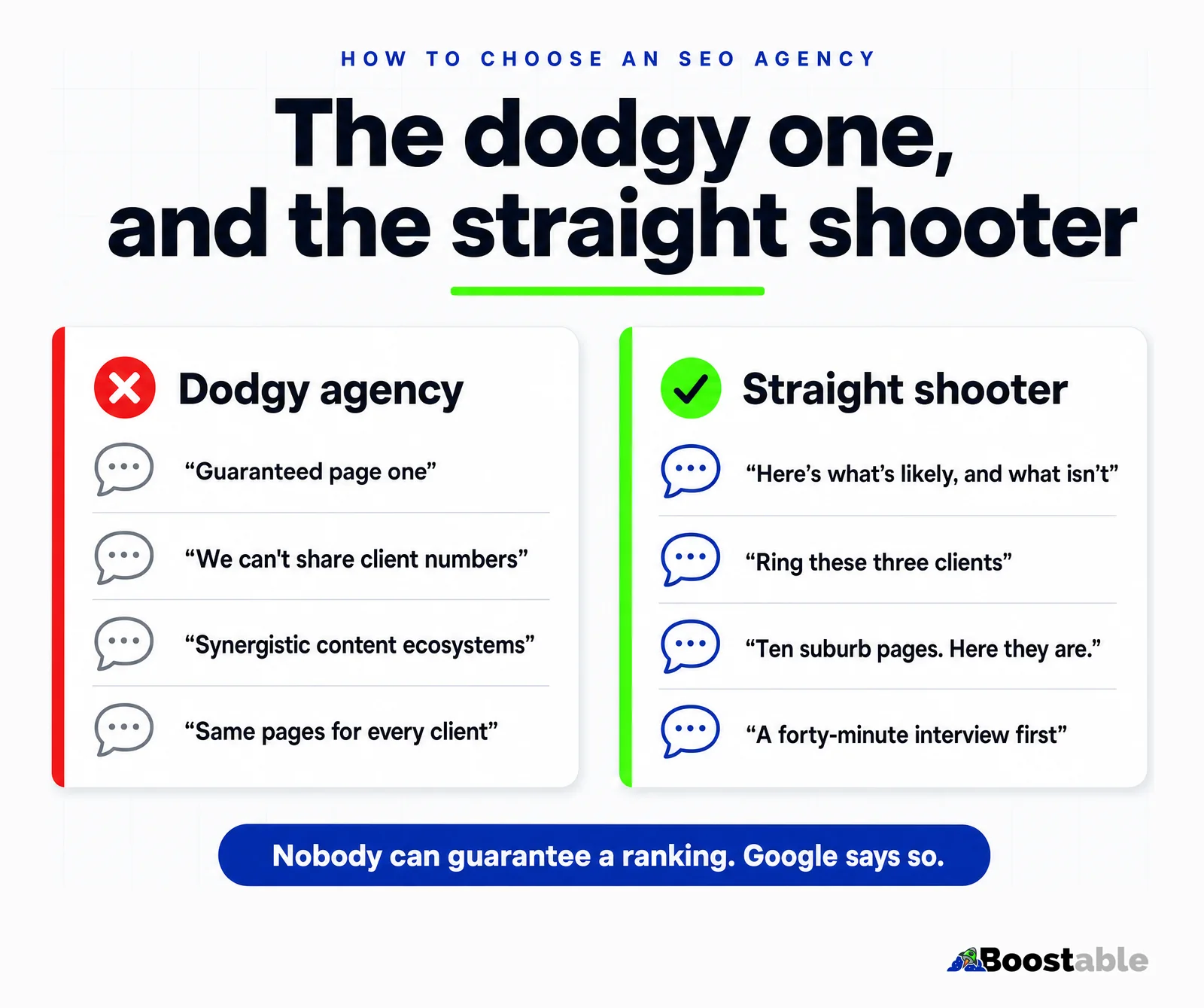
1. They promise page one. Nobody can promise page one. Google's guidance is blunt: "No one can guarantee a #1 ranking on Google. Beware of SEOs that claim to guarantee rankings."[1] Anyone who guarantees a ranking is either lying or about to do something that gets you penalised. Google notes that if an SEO "creates deceptive or misleading content on your behalf, your site could be removed entirely from Google's index," and that "ultimately, you are responsible for the actions of any companies you hire."[1] A proper agency talks about likelihood. Not guarantees.
2. They won't show real client results. Ask to see real numbers from real accounts. Not cherry-picked screenshots, not testimonials with first names only. Ring a current client and ask them straight: is this working? Google's first suggested question is "Can you show me examples of your previous work and share some success stories?"[1] If the agency gets cagey about references, they're hiding something.
3. They use words they can't explain. "We're going to leverage synergies in your content ecosystem to maximise organic lift" is word salad. Google's advice: "Be careful if a company is secretive or won't clearly explain what they intend to do. Ask for explanations if something is unclear."[1] A good agency can say it plainly: "We'll write ten pages about your most profitable services, one per suburb. Here are the pages. Here are the phrases." If they can't explain it to your mum, they probably can't do it.
4. They don't understand your business. The worst agencies run a template: the same phrases for every client in your trade, the same pages with the business name swapped. Google's content guidance asks whether content is "mass-produced by or outsourced to a large number of creators" so that "individual pages or sites don't get as much attention or care,"[2] and ranks pages that are useful to the customer. Template pages are useful to nobody. Google's hiring advice says the same in one line: "See if the SEO is interested in you and your business. If they're not interested, find someone who is."[1]
The four things to look for instead
Flip every red flag and you've got a shortlist.
Experience in your industry and your area. Not essential, but a plus, and two of Google's own questions: "What's your experience in my industry?" and "What's your experience in my country/city?"[1] An agency that's done five arborist sites will ramp up faster than one that hasn't.
A straight explanation of the process. They should be able to tell you, step by step, what they'll do in month one, two and three. Google's version: "What kind of results do you expect to see, and in what timeframe? How do you measure your success?"[1]
Transparent reporting. Monthly numbers you can read: which searches you rank for, and how many strangers rang or filled in the form. Not a vanity dashboard with "impressions" on it. Calls and forms are what Google Analytics calls key events, "an action that's particularly important to the success of your business,"[6] and a serious agency sets them up in month one so the report means something.
Pricing that matches the work. Not a one-size retainer for a business that barely has a website to start with. A plan that starts with what's actually broken.
| Google's question[1] | A good answer | A bad one |
|---|---|---|
| Can you show me previous work and success stories? | "Here are three clients. Ring them. Here are the pages we wrote." | "Client confidentiality." |
| What results do you expect, and in what timeframe? | "Easier searches in three months, the map box in about six." | "Page one, guaranteed." |
| How do you measure success? | "Calls and forms from strangers, counted every month." | "Impressions and domain authority." |
| What's your experience in my industry and city? | A straight answer, even if it's "not much, here's how we'd learn." | Changing the subject. |
| Will you share all the changes you make, and the reasoning? | "Every page, every edit, in a monthly note." | "Trust the process." |
What to ask in the first meeting
Take Google's list to the pitch and don't be polite about it. Can I speak to three current clients? Can I see the content you wrote for one of them? What will the first ninety days look like? How will you report progress each month? Will you share every change you make to my site, and why? And the one Google doesn't list but should: what will I own if we part ways in a year?
A good agency has answers ready. A dodgy one will try to change the subject to algorithms.
"Not only did Boostable provide us with a professional website, help us set up our Google Business profile, and create review request cards, but the team also used various intricate marketing strategies to boost our overall internet and location presence providing us with a higher influx of leads and new clients than we could ever have imagined!The team always explained everything clearly, made sure we were always on the same page and was really exceptional to work with.It was my first time going into business so I wasn't quite sure what to expect, however after hiring the Boostable Marketing Agency, to provide SEO Services for our Local Wangaratta Cleaning Company, the results were incredible!Originally when we first started out, our advertising consisted of a paper ad posted at the local Woolworths from which we were only receiving 1 or 2 leads a week...However, after our experience with Boostable's digital marketing strategies, within the website, Google Business profile, and blogs, we now get around five leads a day!Thanks to Boostable, not only are we appearing in the AI overview for a google search, but we've even been told by clients that Chat GPT is recommending us over other local longer established cleaners.Boostable has even helped us appear at the top of search results in towns outside our local area. This has helped us reach more people and gain new clients in areas we wouldn’t normally reach.Its been only about six months now, but thanks to Boostable Marketing Agency Melbourne, we've built a client base large enough that we are preparing to take on multiple employees.We have received compliments on the appearance of our website, we frequently appear as #1 in local cleaners businesses in google, and Tam and Max have set it up so that the leads flow in from my website and I am notified straight away.Based on my experience with the team, I would say that Boostable's services have extremely good value for money and would highly recommend Boostable to anyone who is looking to build their business and client base efficiently, professionaly and with ease.Thankyou very much to the team at Boostable!"
Hamish Buchan ★★★★★ Verified Google review
The pricing question
You'll hear wildly different numbers: $500 a month, $5,000 a month, $50,000 a month. In our experience, proper SEO for a small local business in Australia sits somewhere between $1,500 and $4,000 a month. Less than that and they probably aren't doing much. More than that and you're paying for an agency overhead that doesn't apply to your size.
Cheap SEO usually means someone's running a template and sending you a report. Expensive SEO usually means a senior person thinks your account is worth their time. Watch the contract term as closely as the fee. A twelve-month lock-in before any result has been shown protects the agency, not you; month to month, with a clear plan and clear numbers, keeps both sides honest. The middle is usually the right zone on price, and the number matters less than what it buys: pages you can read, numbers you can check, and everything in your name. With 97.3% of Australian businesses being small businesses,[7] the agencies are mostly selling to people who've never bought this before, which is exactly why the questions above matter more than the price.
Own your stuff
This is the one most people miss. Before you sign, check what you'll own. Your domain, always in your name, never the agency's. Your hosting account. Your website and every page on it, exportable. The content they write, yours, not rented. Your Google Analytics and Search Console, under your Google account. Your Google Ads account. Your Google Business Profile, claimed by you.
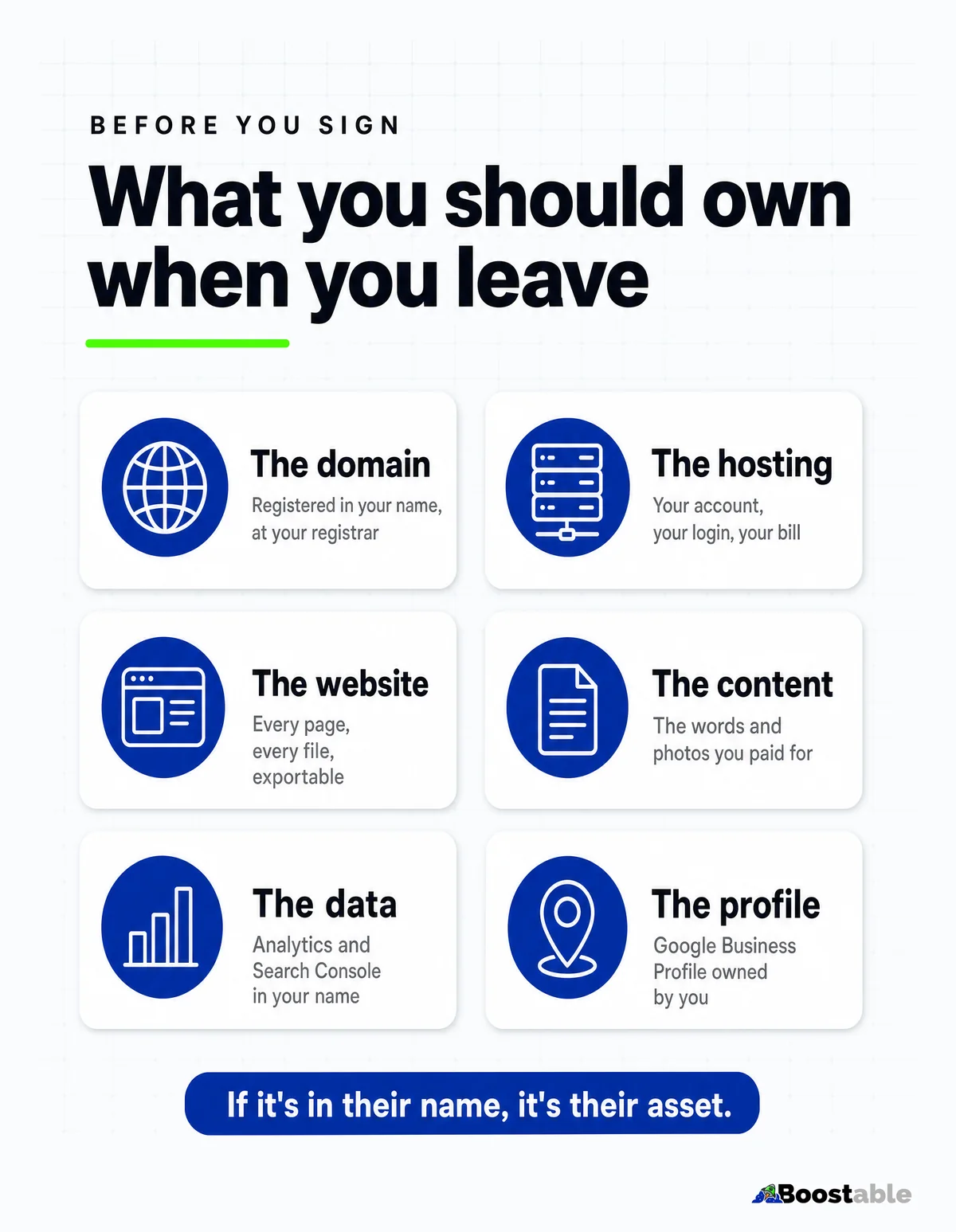
Some agencies keep all this in their own accounts. When you leave, they turn it off and your rankings vanish overnight. Not a conspiracy, just bad practice. Google's guidance puts the responsibility where it lands: "you are responsible for the actions of any companies you hire," and an SEO with access to your site "should be willing to explain all the changes they are making."[1] You can't take responsibility for what you can't see or keep. Make sure your name's on every account before the first invoice.
Whoever you hire, the reviews are yours and the system for collecting them is free.
Get the free review systemWhat the work should look like from the outside
You don't need to understand SEO to check whether it's being done. Open the pages the agency writes. Do they say what you do and where, in the words a customer would type? Google's ranking explainer says the most basic relevance signal is when a page "contains the same keywords as your search query," particularly "in the headings or body text."[4] Its starter guide says to "think about the words that a user might search for."[5] If the pages read like they were written about a business you don't recognise, they were.
Open the Google Business Profile. Is the category right, are the services filled in, are the service areas set? Google says "businesses with complete and accurate info are more likely to show up in local search results."[3] Look at the reviews. Are they real, and are they being asked for on every job? The ACCC is clear that fake reviews are against the law,[8] so an agency offering to "handle" reviews for you should be able to say exactly how. And look at the monthly report. If it doesn't tell you how many strangers rang, it's a dashboard, not a report.
✓ Worth a shot
✗ Keep looking
- "Guaranteed page one"[1]
- An hour on "algorithms" and "domain authority", no questions about you
- A contract that locks you in for twelve months before any result
- The domain or the profile would sit in their account
- A report that measures impressions and nothing you can bank
"Knowledgeable, follows up with customers and has had some great advice. Would recommend"
julian Di Pasquale ★★★★★ Verified Google review
The quiet truth
A good SEO agency earns its fee back in the first few months by stopping the bleed somewhere. A bad one bleeds you slowly for years. The test is simple, and Google wrote most of it: can they explain in plain words what they'll do and when you'll see results, can they show you real numbers from real clients, and will you still own everything if you walk?
- Ask for three current clients and ring them. Ask "is this working?" and "what do the monthly reports show?"
- Ask to read two pages they wrote for a client in a trade like yours. Would a customer understand them?
- Ask for the ninety-day plan in writing, with a timeframe for results and how they'll be measured.
- Ask who will own the domain, hosting, site, content, analytics and profile. Get the answer in the contract.
- Ask how they get reviews. If the answer isn't "we ask every customer," ask again.
- Apply the smell test. Did they ask about your business, or talk about themselves?
For what proper local SEO actually looks like, read how local businesses get on page one and the Star Building Inspections story, with the numbers. And if you'd like a straight look at your site from someone who'll tell you what's broken before asking for a dollar, that's what our SEO service starts with. Ask the hard questions. Then pick the one who answers them plainly.